There are not too many plays that spotlight maths, and perhaps for good reason. Yet in this engrossing revival of Tom Stoppard’s time-jumping epic, maths, sex and artistic brilliance all collide in this layered, provocative work.
Stoppard’s work moves us between two eras, though in both storylines, two centuries apart, the aristocratic home, Sidley Park, serves as the piece’s base. In 1809, the plot focuses on precocious teenager Thomasina Coverly, a mathematical whizz whose tutelage from charming lothario Septimus Hodge threatens to be more than just solving equations. Meanwhile, in the play’s present, set just before the turn of the millennium, conniving literature scholar Bernard is trying to thread together events at the house in 1809, chasing an elusive lead that hints at Lord Byron’s time at Sidley Park although requiring Hannah Jarvis, a scholar in her own right and with a bone to pick with Bernard’s, assistance.
There is a lot to unpack, but Stoppard’s script, and its meticulously threaded four-act structure, gives enough time for each plotline to organically playout. It is also a story that focuses a great deal on desire and the dangerous and playful impact of pursuing one’s desire, and how those desires and choices pull people together or thrust them apart. Whether it is Thomasina’s probing of what ‘carnal embrace’ is, or Bernard’s interweaving of power and lust, Stoppard’s play is clear in its combining of physical and metaphysical longing, all against the backdrop of Thomasina’s interrogation of ‘chaos theory’, a concept that reflects the clash between fate and free will, and the butterfly effect. With so much happening and such complex philosophical thought at the fore, it could so easily get lost among the play’s lengthy exchanges, Carrie Cracknell’s direction and Alex Eales’ gorgeous set design breathe great clarity into the work.
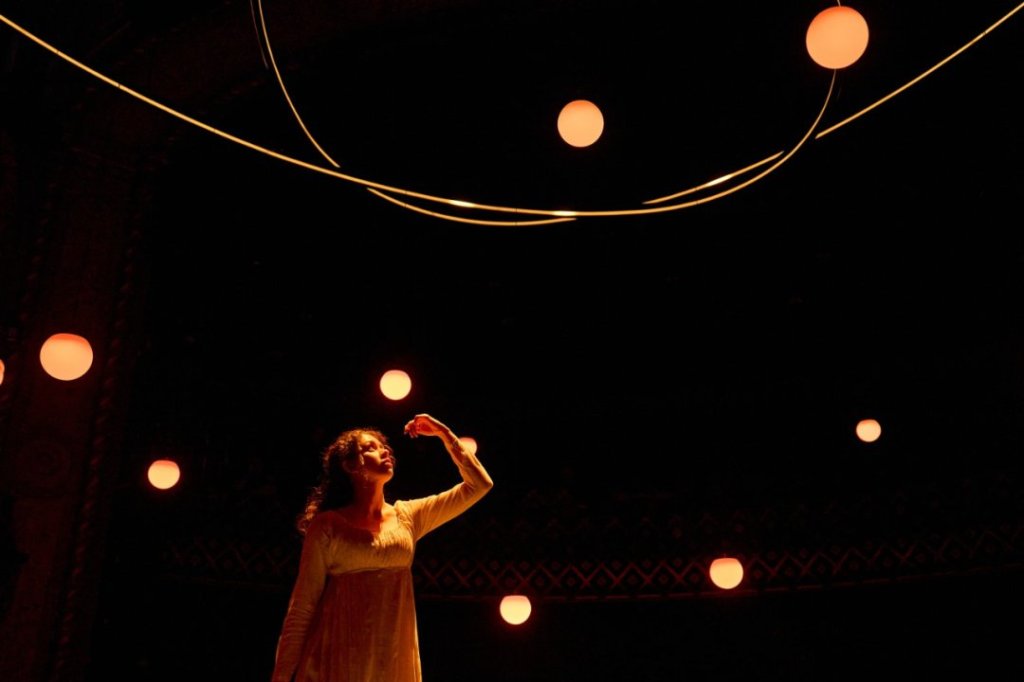
As Thomasina, Isis Hainsworth balances her character’s thirst for mathematical knowledge with a desire to understand the world around her in a more intimate manner. Hainsworth offers a terrific portrayal here, combining well with Seamus Dillane’s Septimus Hodge to bring out Stoppard’s flirtatious dialogue between the pair. It is a relationship between tutor and tutee which hinges upon power, with both excelling in portraying their respective characters’ attempts to one-up each other. Both also succeed in bringing great clarity to the fiercely intellectual debates the pair have with each other. The in-the-round configuration aids here, with the pair encircling each other, particularly as Thomasina relishes in her mathematical exploits.
Dillane, meanwhile, is equally as terrific in presenting Septimus’ love-rat nature. This propels much of the humour, and sexual puns and innuendos of the first half, with Septimus taking great glee in openly cuckolding Matthew Steer’s goofy writer Ezra Chater, whose buffoonish acceptance and even gratitude at Septimus’ treatment of Ezra’s wife’s ‘honour’ provides an endless amount of well-landed punchlines.
Almost two centuries later, scheming academic Bernard (performed terrifically by Prasanna Puwanarajah, who immediately draws out Bernard’s loathsome, misogynistic nature), arrives following a lead on Byron. In essence, Bernard is looking to fill a time gap in Byron’s life, but relies on Leila Farzad’s wonderfully curt Hannah for help. Hannah, brutally put down in her own study of Byron by Bernard and other academics, is rightfully cold, although eventually drawn in by Bernard’s pleas. Farzad is particularly strong as Hannah and threatens to steal the show in a wonderful individual performance that hits almost every emotion, though Hannah’s glee at Bernard’s professional and personal catastrophe is a highlight. The present, though, feels a little rougher around the edges than the narrative in the past, with the peripheral characters being given less time to develop than their predecessors.
At face value, the pair of narratives should not coexist, yet that is the essence of the play where ideas about existence, choice and fate are all ruminated upon, bringing together two stories where beliefs and desires intersect with both tender and potentially ruinous consequences. Furthermore, Eales’ rotating set, with an outline of electrons fizzing around a butterfly-shaped structure, nods nicely to the notion of elements, personalities and ideologies all clashing at speed in this play, mirroring chaos theory.
There is plenty of dialogue to luxuriate in with Arcadia, yet its most powerful, most poignant moment is one at its conclusion, which has little sound. While you can drift in and out of the characters’ lengthy duologues, this play about connections, choices and what pulls people together is one that is, in its sharpest moments, as thrilling for the audience as solving a new mathematical problem is for Thomasina.
It is a subtle, complex piece of theatre, and just about easier to follow than chaos theory.
What else have we seen recently? Check out our latest reviews.





 Read About Stuff | London Theatre Reviews & Culture