This review was originally written for The Reviews Hub: https://www.thereviewshub.com/ghost-grandma-hen-chickens-theatre-london/
What should be an interesting premise suffers from a banal execution in this lacklustre comedy.
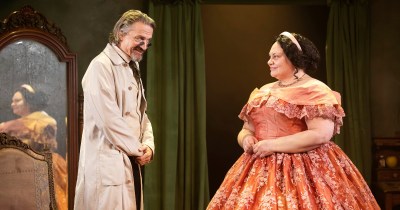
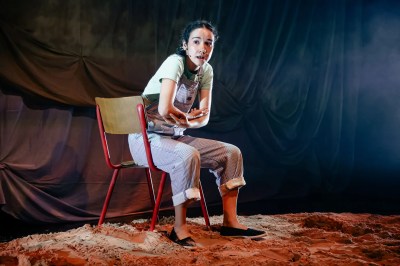
Ghost Grandma sees Dee (Anamika Srivastava) arrive at the request of her deceased Grandma’s lawyer (Yusuf Bhaimia) at her Grandma’s house, with it soon becoming apparent that her estranged relative has left Dee her enormous home. As Dee begins to reflect on the quick financial grab she could make by selling the house, her Grandma (Selina Patankar) soon appears to haunt her and attempt to connect with Dee to see if she is fit to be her ‘heir’.
It is a neat idea, but one that is lost among outlandish, buffoonish, caricature characterisation that robs the play of any meaning. Dee’s character is almost from another planet, completely unaware of how the world works, obsessed with social media and otherwise without much depth. This, unfortunately, is coupled with a cast of characters who reside in the same property, with a daft subplot of the residents plotting to take the house themselves, an unnecessary distraction in a play that just hits the hour mark.
Arista Abbabatulla’s direction leans too much into outlandish, goofy asides. The bizarre yoga-enthusiast Dolly (Ayse Muge Bakir), on the rob of Grandma’s things, flails around the stage while the devious couple Wife (Jasmin Williams) and Husband (Gosteloa Spancer) feel like side characters in a sitcom, with increasingly unbelievable reactions and behaviours.
This is a shame, as when the play attempts to give the characters some emotional balance, there is some impact. Dee’s revelation about her lost parents, and her Grandma’s devastation at her own stubborn behaviour, which resulted in her estrangement from her daughter and granddaughter for 20 years, is a poignant moment, and one that the play could use more of.
The connection between Srivastava and Patankar, and their characters, eventually feels authentic and hints at what the play is ultimately aiming for in terms of familial bonds. Indeed, the burgeoning relationship between the pair sparks some interest, but this is quickly eroded with clumsy punchlines and sloppy slapstick, not helped by some unfortunately timed technical miscues.
The play is also hindered by an array of plot holes, which negatively impact it, too. Dee manages to own and potentially sell the property without actually finding her Grandma’s missing will, or even being given the keys. Houses seem to change hands on just one sheet of A4, and within just a couple of hours of the funeral. This again detracts from letting the audience focus on the relationship.
As an idea, Ghost Grandma has a lot of potential, and it is fantastic to see South Asian voices, especially those of South Asian women, being given deserved stage time. Yet the play is trying to do too much and, as a result, struggles to do anything to great effect. If the team revise the script and places a renewed focus on the growing bond between Grandma and Dee instead of all the other fluff, the play won’t be nearly as ghostly as its current form.









 Read About Stuff | London Theatre Reviews & Culture