This review was originally written for The Reviews Hub: https://www.thereviewshub.com/death-on-the-nile-marlowe-theatre-canterbury/
There is moustache twiddling aplenty as Agatha Christie’s iconic Belgian detective, Hercule Poirot, investigates a poisonous love triangle in this lavish production of Death on the Nile.
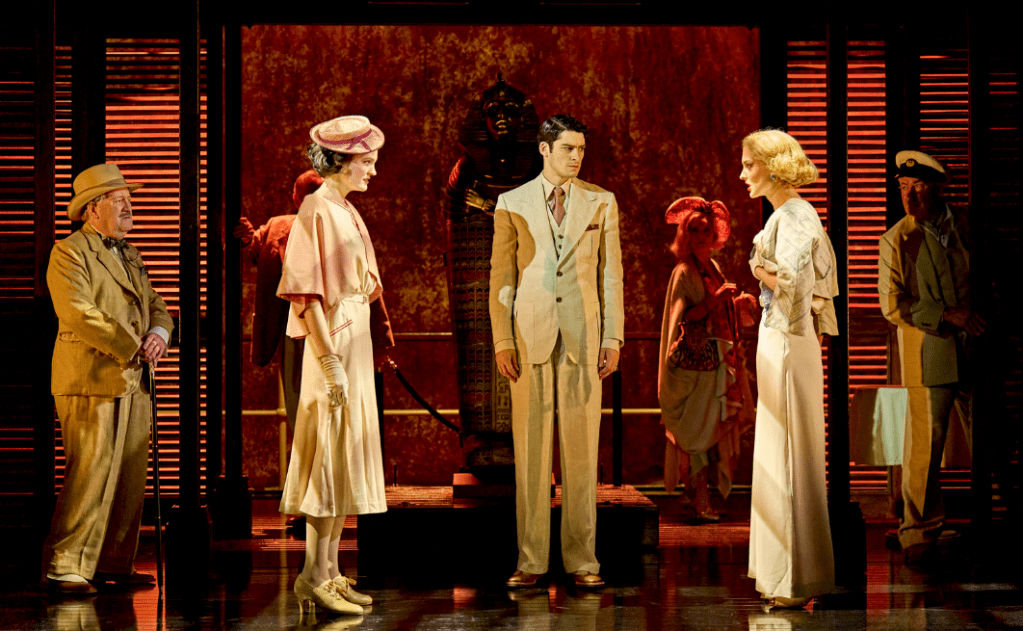
Ludwig’s adaptation gets us on board the S. S. Karnak, where Poirot and a number of guests are travelling along the Nile as part of a group returning an Ancient Egyptian sarcophagus. The omens are pretty obvious from the start, and become even more looming as heiress Linnet (Libby Alexandra-Cooper) and new husband Simon’s (Nye Occomore) are tracked down by stalker Jacqueline, former fiancé to Simon and best friend to Linnet. When one of the trio is gunned down, suspicions fall on the ship’s cast of characters to find the murderer.
As Poirot, Hadfield captures the charismatic, playful yet methodical investigator with aplomb. Hadfield’s shuffled movement enables Poirot to drift in and out of scenes, and in and out of other characters’ private conversations, slowly and methodically piecing the work together. It is a recognisable portrayal of Christie’s iconic character, right down to well-trodden lines about logic and reason, combined neatly with cheeky humour, creating an instantly warm and likeable display.
Alexandra-Cooper’s Linnet, meanwhile, is brash and fragile, with Alexandra-Cooper quickly establishing her heiress’ character’s fragility and vulnerability, aided effectively by Lucy Bailey’s evocative direction, employing choral movement and slow motion to help develop Linnet’s growing fear. Alongside Alexandra-Cooper, Esme Hough’s Jacqueline, meanwhile, is defiant and menacing. As the scorned lover, this is a performance full of fury and potential for violence, with Jacqueline’s character written as the stereotypical jilted ex, desperate for revenge. It is all very melodramatic, but it works well, with Hough’s portrayal neatly slotting into the piece.
Nye Occomore’s Simon, furthermore, is both suspicious and hapless, effectively arousing suspense. Caught between two lovers, his behaviour is one that immediately comes under suspicion, though it takes until the play’s second half to really get into his character.
In addition, the play is supported by an effective ensemble cast. Glynis Barber and Terence Wilton, as Salome Otterbourne and Septimus Troy, provide some neat comic relief, while Bob Barrett’s Colonel Race, Poirot’s friend, likewise brings balance to the play’s murderous plot with good humour.
However, the pacing of the production feels a little too plodding. It is a piece well acted and well performed, but for a murder mystery, it simply takes too long, actually, to get to any deaths. The play takes a lot of the first half to establish exposition, presenting characters’ relationships and their reasons for potential villainy, which is necessary yet, albeit a little frustrating, moving much more quickly and with greater intrigue once Poirot’s investigation kicks off.
It is in the design, though, where this production fully comes into its own. Mike Britton’s gorgeous, multi-level set design perfectly captures the various decks of the ship, and enables characters to hide behind pillars and sneak past doors to add to the mystery. The flying flats, opening and closing to expose various living quarters, are atmospheric and bring a cinematic quality to this mystery, yet despite the set’s grandeur, it still manages to maintain an intimacy, such as during the inevitable final reveal, in the saloon, with a proud Poirot, that evokes intrigue.
Although it takes a little too long to get into the actual murdering, it is a production full of red herrings, sideward glances and multiple motives that help keep the piece moving to a strong conclusion, which, despite some tweaks for the source material, lands with success. Poirot’s logical dedication is a little obvious, but it is another strong outing from Belgium’s famous sleuth.









 Read About Stuff | London Theatre Reviews & Culture