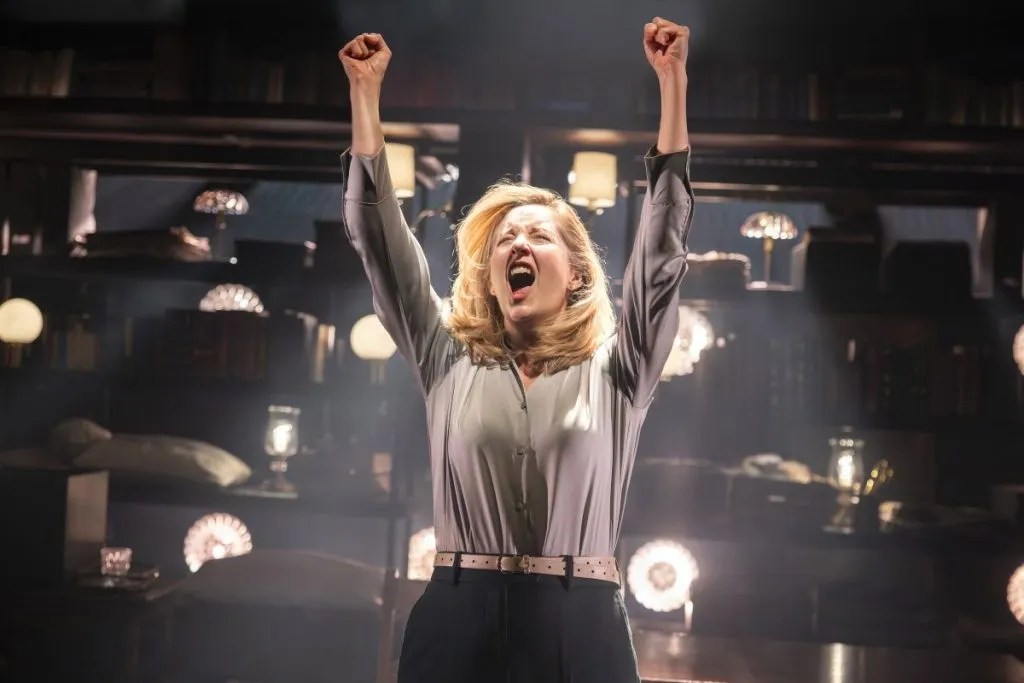
The literary canon is full of dysfunctional relationships, yet one in particular, the chaotic marriage between F. Scott and Zelda Fitzgerald, continues to spark intrigue a century on. It is this furious union which is focused upon in the enthralling new musical Beautiful Little Fool.
Taking its title from The Great Gatsby and with ideas about female oppression, the musical, through the eyes of their daughter Scottie, explores the relationship, warts and all, between F. Scott, fearful of artistic failure, and Zelda, fearful of being unable to express her artistic desires. Indeed, the musical focuses as much on Zelda’s creative frustrations as it does on their frantic marriage, leading to its brutal collapse and, in part, their untimely deaths.
It starts sweetly, though. Backed by Hannah Corneau’s score, which opts for rock rather than anything representing the Jazz Age, which mostly works, Scottie (portrayed by an incredible Lauren Ward) narrates the tender beginnings of her parents’ relationship. In these moments, David Hunter, F. Scott, and Amy Parker, standing seamlessly in for an indisposed Corneau, Zelda, are intoxicated and intoxicating as a pair mutually infatuated with the other. Corneau’s score works well here, with more rip-roaring, powerful numbers underpinning the burgeoning relationship before changing tack as the marriage subsides. That said, it needs a little tidying by the finale, with the songs all blending into similarly sounding items, where time may have been better spent tightening some of the predictable dialogue earlier in the piece.
Hunter and Parker find a chemistry in this production that is both passionate and full of rage. It is an ambitious feat that in just 90 minutes we get twenty years of a relationship, and yet, while it is not forced, it does leap from marital bliss to breakdown a bit too quickly. Nevertheless, Hunter’s portrayal of F. Scott’s grappling with vulnerability about his artistic legacy is effectively brought to the fore. Though tonally, the presentation of F. Scott is conflicting. His inspiring writing is contradicted by his abusive behaviour, a little too skimmed over and a victim of the musical’s brief runtime, which could use some further exploration.
It is made clear, though, that our attention should be on Zelda, held back by her husband, revealed with a full-force fury that Parker delivers not just in dialogue but in song too. It is Zelda who is far more intriguing, especially as Parker is excellent demonstrated her multi-faceted character, although her breakdown feels a little abrupt, and one wonders whether the piece may have been better off focusing on just Fitzgerald instead
Ward, though, is effective as daughter Scottie. Mostly serving as a narrator, we see Scottie as an observer of her parents, guiding us through their quirks, charms and flaws, but also pensive as their union unravels. Scottie bursts into life as we hear of how both her parents meet cruel, untimely, demises (in particular Zelda’s, dying in a horrendous fire while in a state institution), but bringing a non-judgemental tenderness too. At the end of the day, these are her parents, and it is a neat idea to allow her to show us them, rather than through a more critical eye. This warmth and heart are brought out with aplomb by an impressive Ward.
Like the Fitzgeralds themselves, the musical ebbs and flows with a speed that matches the flighty nature of the pair. Shankho Chaudhuri’s monochrome set design, littered with books and papers, not only reminds us of the Jazz Age era where the pair meet, but also serves as a reminder of the artistic differences that go some way to fuel the breakdown between them. It is an intimate setting, and one which feels increasingly claustrophobic as both parties struggle with addictions and illness, with one volatile, enthralling argument in which strips are torn off the pair of them, which feels like an extract from Albee’s Who’s Afraid of Virginia Woolf.
As the musical reaches its poignant finale, what remains at the fore is the love the couple shares. Their compatibility and incompatibility made F. Scott and Zelda the perfect match, and the perfect foils to each other, yet their intertwined shared history is powerfully told in this gorgeous, beautiful musical.
While both F. Scott and Zelda missed out on legacies and triumphs in life, their longevity in death makes for intriguing theatre.
Heading to London and not sure what to see? Check out our 2026 big London Theatre Preview!







 Read About Stuff | London Theatre Reviews & Culture