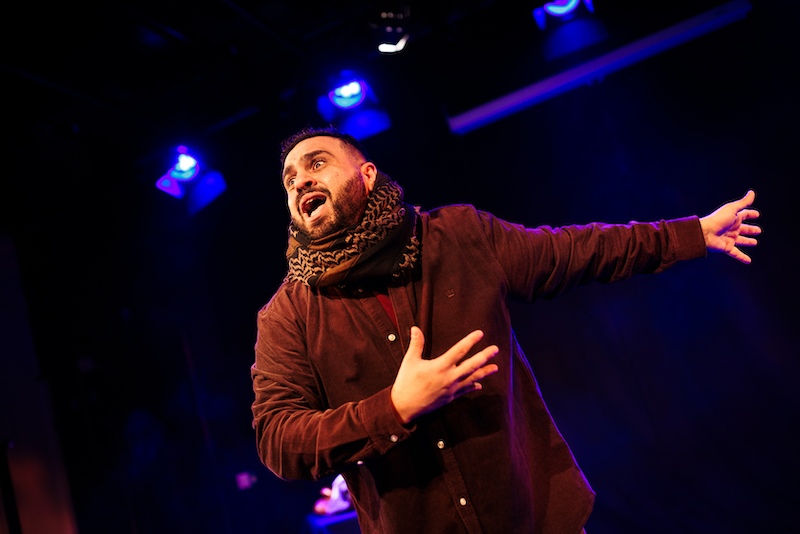
In 2003, a prominent, five-metre-high sculpture of a horse, a symbol of defiance and of resilience, stood proudly in Jenin, crafted from the scattered shards and remains of the devastation caused by occupation in the Palestinian camp. Erected using materials salvaged from homes and vehicles destroyed during the 2002 Israeli invasion of the camp, The Horse of Jenin retells, through Jenin-born Alaa Shehada’s exceptional one-man delivery, how the horse came to be such a poignant symbol for Palestine, and for Shehada, growing up against the backdrop of such unimaginable circumstances.
The Horse of Jenin, part stand-up comedy, part mask-based drama, enables Shehada to retell, through his own words and through characters from his life, what it was like growing up in Jenin. It is a provocative, moving blend of performance styles as Shehada’s larger-than-life comedic persona contrasts the intricate nature of his mask-based clowning sections nicely, drawing from his training as a ‘Clown Doctor’ with Red Noses International.
Shehada’s autobiographical piece, returning to the Bush Theatre following a sold-out run but this time in the main space, rather than its smaller studio setting, adapts well to a slightly larger environment, with Shehada’s experience as a comic proving useful in warming the crowd up during the piece’s initial moments. Despite the play’s devastating discussion of everyday Palestinian life, there is a tremendous amount of humour and warmth throughout the production, enhanced by Shehada’s authentic storytelling.
While the piece takes its name from the sculpture, the play comes to represent the people who lived under its shadow, and quite literally under the sculpture, rather than the artwork itself. Shehada, through hyperbolic, stylised, mask work, brings to the stage a cast of different characters, from the emotional depiction of his grandfather, aged not just by time but by his experiences, to his touching portrayal of his goofy childhood friend Ahmad, who scrambles through the debris not for a loved one, but for his battered PlayStation. It is through these characters that the piece really lands. Shehada is quick to point out the differences between Palestinian and British responses to comedy, but then reflects this back during one humorous exchange. His use of clowning and his use of comedy pulls away from a sense of division, and reflects the real message of his piece, which is about humanity and resilience, and the nature of being human in inhumane conditions.
It is in the absurd normality of life where Shehada’s piece breathes. Audiences are taken through Shehada’s birth, his school life, his first love and his family life in ways that feel typical, despite the atypical conditions. There is an impressive amount of humour to be found in the ‘everyday’ of Shehada’s life, and although the impact of occupation is quite clearly and explicitly brutally felt, it does not define Shehada’s life. Indeed, one exchange, focusing on Shehada’s experiences learning to perform at Jenin’s Freedom Theatre with an overbearing American performance teacher, is utterly brilliant, barmy in its humour, and spotlights a sense of Palestinian life that goes unreported.
This is a gorgeous, heartfelt piece of autobiographical theatre that is completely effective in its blending of mask and stand-up comedy to make a wider point about hope and resilience. Shehada does not flinch away from unearthing some of his life’s most painful experiences, yet he does so in a theatrical experience that feels an utter privilege to be part of.
Heading to London and not sure what to see? Check out our 2026 big London Theatre Preview!



 Read About Stuff | London Theatre Reviews & Culture