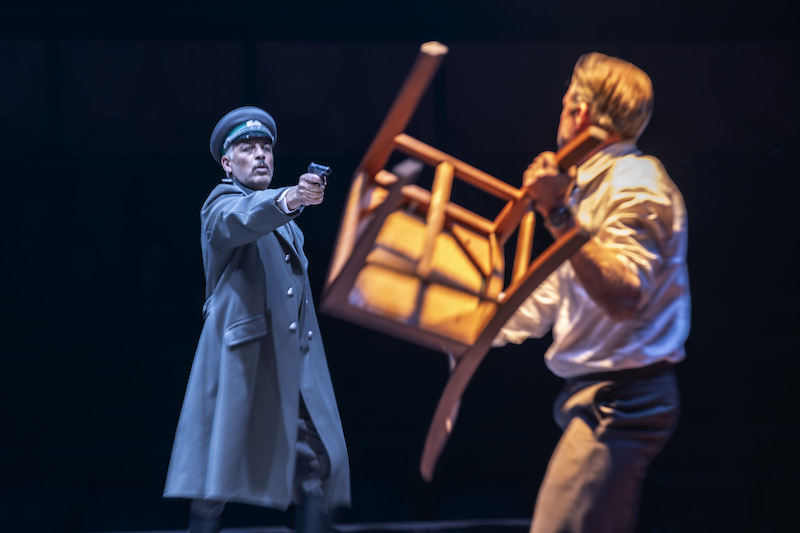
John le Carré’s iconic spy thriller, The Spy Who Came In From The Cold, gets the West End treatment in this gripping stage adaptation, revived from a successful run in Chichester.
David Eldridge’s script, which has the unenviable task of turning le Carré’s work into a two-hour performance piece, more than sticks the landing in what quickly becomes an exhilarating look at spying and its human cost, against the backdrop of the Cold War.
Upon its first publication, le Carré’s novel drew criticism from secret agents who perceived the book to unfairly portray them, and those whom they work for, as callous and manipulative, and this is a trail of thought that Eldridge’s adaptation retains. The piece centres upon fraught spy Alec Leamus (Rory Keenan), who is sent to Holland, and then East Germany, to track down and ‘liquidate’ East German official Mundt (Gunnar Cauthery). Leamus, battling his own suspicions about the British Secret Service, is also swept up in a fierce romance with communist sympathiser Liz Gold (Agnes O’Casey), whom Leamus desperately tries to steer from trouble.
It is a quick-fire production, held together by the tight ensemble led by Ian Drysdale’s stoic Control, while John Ramm’s mercurial depiction of George Smiley immediately helps to shroud Leamus’ situation in suspicion. Keenan’s portrayal of Leamus, fraught with anxiety and a desperation to do a good job and get out of the only work he has ever known, is gripping, and it is a brilliant portrayal of a man on the edge. There are also terrifying moments of torture, which are played brilliantly between Keenan and Cauthery, pushing the boundaries of what is and is not comfortable viewing in a theatre.
Indeed, Eldridge’s script, filled with tension and vague instructions, creates a world of deceit, suspicion and second-guessing that makes this story, and this staging of it, ripe for theatrical success. There are some clumsier exchanges, where the dialogue is forced to move the considerable plot onwards a little, but it largely works, and does well not to get too bogged down in trying to cover all bases.
Jeremy Herrin’s direction makes good use of the theatre’s ‘in-the-round’ configuration. Characters fly in and out at speed thanks to the layout, thus helping the piece keep a steady space as we move across Europe. It is a nice touch to use platformed areas in each corner of the theatre for characters to appear as flashbacks/visions to Leamus, furthering the notion that we are spectating the collapse of this agent, shattering under the pressures upon him.
The piece is aided by Max Jones’ set and costume design, quickly used to immerse us in the different locations with token props and suitable uniforms, which Azusa Ono’s lighting aids, spotlighting the locations emblazoned on the stage floor, which depicts a Cold War era map.
It is a production that will definitely delight fans of le Carré while also drawing newcomers to his work. It is a fresh take on the thriller that pays homage to the source material, rather than changes it beyond recognition, earning gasps from its terrific finale.
 Read About Stuff