
Did this make my top 50 of 2025? Check out Read About Stuff’s Favourite 50 Shows of 2025.
David Harewood and Toby Jones shine in this often pulsating staging of Shakespeare’s classic tragedy about love, jealousy and deceit.
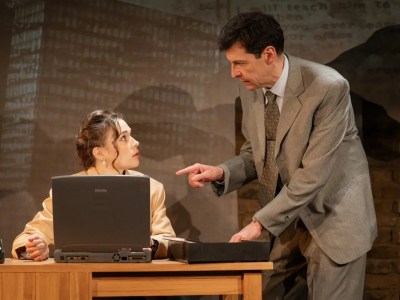
It is a well-trodden story. Initially set in the powerful Venetian courts, Othello then moves to the riotous Venice, where the eponymous tragic hero (Harewood) is meticulously, and cruelly, manipulated by the devious Machiavellian Iago (Jones), into believing that his wife Desdemona (Caitlin Fitzgerald) has been unfaithful. Tom Morris’ direction luxuriates in Shakespeare’s rich language, relying on the strength of Harewood and Jones’ delivery to weave the narrative together, in a production that thrives particularly through the menacing Iago.
Harewood returns to the role that he first played in 1997, marking a significant point in theatre history as the first black actor to play Othello. It is a role that Harewood slips into with ease, carrying a level of poise and grace to the character that is necessary for his elevated status. Such is the nature of the play, Othello does very little apart from engaging in lengthy political discussions and speeches, bar one passionate defence of his interracial marriage, during the first half, yet it is in a pulsating second half, as Othello’s life unravels around him, that Harewood comes into his own. In these moments, it is a fierce and volatile delivery, capturing the collapse of the powerful general in real-time, before the play’s devastating conclusion, reworked for a contemporary setting by Morris yet maintaining Shakespeare’s shocking intentions.
Meanwhile, Jones’ devilish Iago is great fun, and the play makes the most of Jones’ ability to hold the audience’s attention during the villain’s numerous, plotting, monologues. There is a glee to Iago’s mischief that Jones brings out, though Morris’ direction does lean a little too much into the potential for humour, which does throw some of the tragic tension off. Nevertheless, in a play titled Othello, it is just as much about Iago and his web of deceit and through Jones, the play benefits from his deliberate, articulate, control of the language that brings with great clarity even the most inaccessible Shakespearean imagery.
As Desdemona, Fitzgerald is strong-willed and captures the senator’s daughter caught in the crosshairs of Iago’s plot successfully. It is a complex role, where Fitzgerald balances the helplessness of the character calmly with her determination and ingrained social status, and this makes the inevitable conclusion, again reworked for a more modern, more violent, production, even more shocking.
Such is the production’s focus on the language that its design is often complementary, rather than in the way, and this largely succeeds. PJ Harvey’s slow notes, full of dread, provide a suitable underscore, especially as the play’s climax draws nearer, while Ti Green’s set design, which starts off with lavishly golden frames before reducing the space to holding a mere bed, represents the stark breakdown of Othello and his relationship. It is a shame that more risks are not taken with this design though. The decision to bring the lighting rigs closer to the bed to create a sense of claustrophobia works well until they are suddenly, and seemingly unnecessarily, retracted, while Nina Dunn’s projection, a clever use of multimedia to show us Othello’s tormented thoughts, seems to only fit on some of the projected targets. It is a bit confusing, and a shame because, despite such acting prowess, the production never fully hits its full potential as a result.
Nevertheless, this production of Othello is carried largely by its tremendous leads and is certainly worth admission on that alone. The speed of the first half in particular is terrific, and builds a strong momentum towards the inevitable chaos, enabling a slower second half to linger over moments of dread much more severely and impactfully. It is a powerful, character-driven production of this tragic classic, culminating in an absorbing ending that rightly draws gasps as the lights fall.



 Read About Stuff | London Theatre Reviews & Culture