
Did this make my top 50 of 2025? Check out Read About Stuff’s Favourite 50 Shows of 2025.
It is a modern-day feminist story told through the lens of an early modern witch trial in the fiery new musical, Coven.
The musical centres around several women held as prisoners amid a wave of sham witch trial prosecutions that gripped Pendle in the first half of the 17th century. Jenet Device, once an accuser of witches, finds herself in the spotlight as she and a group of marginalised women face the gallows for supernatural crimes.
Gabrielle Brooks delivers a stunning turn as Jenet, energising the musical with a performance that hums with raw emotion. Her musical numbers soar with unfiltered power, yet it is the quieter moments, when the weight of coercion pushes against her chest, that truly ignite the character, marked brilliantly by the inclusion of an eerie puppet mimicking young Jenet that haunts her flashbacks. Brooks charts Jenet’s dawning realisation of the horror beneath the witch trials with a clarity that is gripping. It is an unflinching portrayal of a woman battered by forces larger than herself, and reaches a devastating climax, especially when the revelation of what led to Jenet’s previous accusations towards her family is made clear.
Shiloh Coke brings equal intensity to the role of Frances, a wife whose desperate faith becomes both shield and prison. The devout precision of Coke’s characterisation initially offers a sense of steadiness, but this is soon pierced by devastating revelations about her lost pregnancy. The script repeatedly touches on the abuses suffered by women at the hands of men, and within this framework, Coke’s work becomes the most brutal. She embodies the deep internal conflict of a woman forced to reconcile devotion with trauma, and the performance is painfully absorbing. Her scenes ring with emotional truth, landing with a force that echoes long after the curtain falls.
Lauryn Redding breathes fire into Rose, a young woman carrying the child of Frances’s abusive husband, who is both a priest and a land baron. At first, Rose’s ferocity borders on overwhelming, a barrage of raised voice and anger. Yet as the reasoning behind her behaviour emerges, the portrayal settles into something richer and more resonant. Redding becomes the embodiment of the working-class women who were often the first to be targeted in witch hunts. Once her vulnerability surfaces, the earlier outbursts reveal themselves as armour, and the performance gains both poignancy and depth.
Much of Coven’s power comes from its dynamic ensemble, who maintain the pulse of the production with seamless musical work and an unrelenting stage presence. The interplay between group scenes and intimate moments keeps the momentum high, leaving very few passages that sag. The energy builds convincingly toward a finale that feels both cathartic and chilling. Diana Vickers adds a sharp edge as the vicious prison warden Covell, her presence darkly impacting in its cruelty, while Jacinta Whyte’s spiritual figure Maggie provides a gentler counterpoint, grounding the musical in quiet resilience.
If the musical falters anywhere, it is in the score itself. Very few of the songs stand out as instant favourites, and the variety of genres can make the early stages feel difficult to grasp. The music takes time to settle, and some numbers pass without leaving much imprint. Yet ‘Burn Our Bodies’ emerges as a fiery exception, its lyrical and emotional force burning through the ambiguity and lighting up the stage with fierce precision.
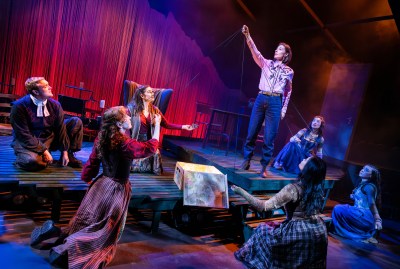
Furthermore, Jasmine Swan’s design, especially the set, is provocative in evoking an eerie atmosphere that forcibly pens the women into a smaller downstage space, representing their entrapment. A rostra, in addition, works nicely for scenes ‘above ground’, such as in the courtroom, but the notion of these women being buried under reality is a deft touch to the erasure of these women’s stories over time. The lowering of violently shaped branches towards the end, and some projections, add very little, yet the combination of onstage effects and the bleakly grey prison cells is nevertheless impactful.
Coven succeeds most powerfully when it lifts the voices of the women it depicts, threading anger, grief and solidarity through a narrative that refuses to look away from historical cruelty. While the score may not lodge itself immediately in the memory, the performances, especially those of Brooks, Coke and Redding, carve themselves deeply into the experience. The result is a bold and haunting piece of theatre that demands to be seen.




 Read About Stuff | London Theatre Reviews & Culture