
Did this make my top 50 of 2025? Check out Read About Stuff’s Favourite 50 Shows of 2025.
Hot on the heels of the scintillating The Picture of Dorian Gray and before bringing Cynthia Erivo to London in Dracula, visionary director Kip Williams has given his technologically charged ideas to Jean Genet’s The Maids, in this pulsatingly tense production.
Williams’ new version keeps the same three characters. Solange (Phia Saban), an increasingly reckless and disturbed maid, and her sister, the controlling Claire (Lydia Wilson), are playing a series of increasingly violent and disturbed set of role-plays, which fantasise about murdering their Madame (Yerin Ha). The sense of Genet’s original is maintained in this piece, but Williams shifts it to give it a more contemporary focus, with Madame now being a social media influencer, powerfully bolstered by millions of followers with a lifestyle catered for by her two maids.
It is the spectacle of the production where The Maids, and Williams’ direction truly shine. Characters live-stream Snapchat filtered distortions of themselves, and control the music with onstage iPads, in a way that helps to blend what is real and what is not, in a play that indulges in this clash. The projections are vibrant and dominant, and provide a great addition to the violent plotting in the dialogue. This does get a little too carried away with itself in a barmy conclusion, but the inclusion of screens, projection and sound in this high-tech production works effectively.
The Maids is an urgent production, with dialogue fired across the stage with such rapidity that the 100 minutes fizz by, full of tension and double meanings as Solange and Claire’s plot to murder Madame moves from fiction into a dangerous reality.
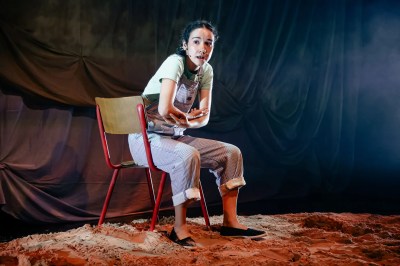
Saban’s Solange, initially the weaker of the maid duo, but evidently with a greater potential for danger, is played with great erraticism. Frequently sprawled across the plush carpet, in Madame’s swanky, modern bedroom, lavishly designed by Rosanna Vize, Solange’s enjoyment in having her sister role-play as Madame, and degrade her provokes a chilling and uncomfortable atmosphere.
Wilson, meanwhile, is initially dominant as Claire, both in ‘role’ as Madame and then as the maid herself. It is a poised portrayal of a woman whose own identity is warped by the control of those who oppress her, in this case, Madame, with Wilson’s ability to switch between the two aiding to establish the blend of reality and fiction during a rapid opening exchange.
Ha’s vacuous, self-absorbed influencer Madame is excellently crafted, with Ha floating around her bedroom throwing clothes on and off in fits of indulgent rage, in an instantly loathable introduction. Despite being the supposed murder victim, it is deliberately difficult to sympathise with the character, which Ha and Williams’ version maintains with success.
Although a bit overdone in its closing moments, The Maids is a terrific look at identity and how powerful individuals can control those who look up to them. Williams’ imaginative social-media-laden revival succeeds in reigniting Genet’s classic for a modern follower.





 Read About Stuff | London Theatre Reviews & Culture