
Did this make my top 50 of 2025? Check out Read About Stuff’s Favourite 50 Shows of 2025.
Brendan Gleeson leads a brilliant cast in this quietly riveting revival of a tale of ghost stories and the pasts which haunt us, set in a dank Irish pub.
Conor McPherson’s script is, at face value, reasonably simplistic. The play revolves around four men, who all have connections to this sleepy Irish backwater, being pummelled late one evening by harsh winds. Joining the men, a woman, a ‘blow-in’ from Dublin who listens to the quartet, reveals stories about themselves and their home, rooted in Irish folklore, and representatives of the myths and tales that follow us, before sharing a horror of her own.
Gleeson’s Jack is stoic, ever-present, kind, Brendan’s (Owen McDonnell) unassuming, run-down pub, perched on a bar stool and drinking the hours away as the evening slips past. It is a quietly poised portrayal of a man who himself is caught in a crossroads of longing for a life lost, and reflective of the lonely life ahead. Gleeson blends these compelling emotions nicely, particularly during the play’s closing moments, providing a gentle contrast to the fiercely tongued, typical man’s man, initial presentation. Gleeson, who as part of this production is returning to the stage for the first time in a decade, looks at ease throughout, using subtle gestures and a measured expression which makes Jack’s character hard to make out, and more intriguing.
Alongside Gleeson, Seán McGinley’s Jim, a bit slow, is much like Jack in that he represents a character typical of one would find in such a rural pub. Glued to his betting notes, Jim’s odd quips, and simplistic nature, disguises something slightly more complex underneath as, like Jack, Jim uses the pub and those there as a form of comfort and belonging amid the backdrop of a dying ‘Mammy’, who is continually mentioned. It is through Jack and Jim’s relationship, the bond men make in such an environment, that the play thrives in its nature. There is not a lot that particularly goes on in McPherson’s script, yet the authenticity of the connections between these men is engrossing.
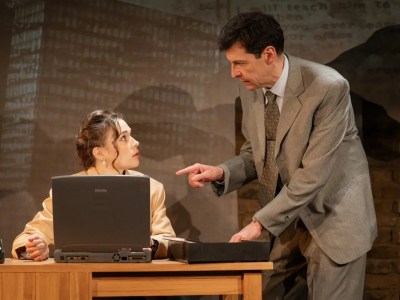
Contrasting the unassuming pair is the bold, brash, ‘new money’ Finbar (Tom Vaughan-Lawlor), who swans into the pub and quickly makes himself known. Finbar is already a point of gossip before arriving, a married man who is seen galivanting around the sleepy town with new arrival Valerie (Kate Phillips), and his flash suit and over-the-top desire to impress earn, quickly, some neat laughs. Like Jack and Jim, Vaughan-Lawlor’s Finbar is instantly recognisable for anyone who has spent time in such a pub, and his ‘carrying on’ is deftly derided by the other characters. There are flashes of tension, particularly between Jack and Finbar, whose similar upbringings are now a distant past, yet these are soon nipped in the bud; there is no conflict here in a place that feels focused on survival.
It is through the arrival and eventual focus on Phillips’ Valerie where the piece really turns. The men initially impress, and shake Valerie with tales of ghouls and fairies, typical old folk tales that every small town or village knows, and ones that are passed through generations. These generational stories, or traumas, are numbed by this point, becoming tales that unsettle but are also capable of being quickly dismissed as fiction. Yet through Valerie, whose ghost story is much darker, although slightly too obvious, the play pivots to one about losing a sense of self in the face of unimaginable pain. Valerie’s monologue, a little long, is deftly delivered by a composed Phillips, and helps to shift the tone of the play into something more meaningful.
By the end of the play, in truth, not a lot has happened. It is not a play driven by plot, but more a slow, evolving piece that pays attention to the horrors which linger, and the ghost stories we tell to perhaps deflect those we do not want to say. Aided by Rae Smith’s gorgeous design, this is an intimate exploration of who we are and what makes us, and it is a quietly riveting experience.



 Read About Stuff | London Theatre Reviews & Culture