
Did this make my top 50 of 2025? Check out Read About Stuff’s Favourite 50 Shows of 2025.
Tracy-Ann Oberman shines in this gripping drama, which sees one family over the course of two Christmases, twenty years apart.
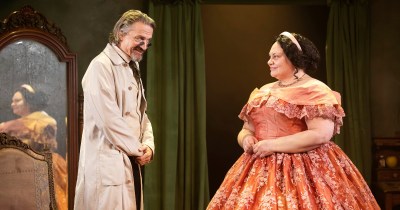
Richard Greenberg’s comedy, full of barbed punchlines and side-swiping undertones, centres upon former movie starlet Julie (Jennifer Westfeldt) who, despite her family’s Jewishness, is insistent that Christmas, and most importantly the festive feast, is taken seriously.
Against the backdrop of Julie’s relentless sweetness, husband Ben (Daniel Abelson) is dealing with pressure from conniving brother-in-law Mort (David Kennedy), whose own wife, the formidable Faye (Oberman), is wrestling with the imminent demise of her battleaxe mother. Meanwhile, law-bound son Scotty (Alexander Marks) is having an existential crisis, while his college friend Jeff (Sam Marks), a guest for the holidays, seems to be using the festivities as a coping mechanism for his own family’s deficiencies. It is a blend of typical familial chaos, yet Greenberg’s dialogue makes almost every interaction feel urgent and authentic, as truths, on either side of the twenty-year time jump, look set to be revealed.
Oberman’s acid-tongued Faye is brilliantly biting, in a portrayal that dominates the production. Oberman oozes confidence in the role, with Faye’s cutting remarks balanced with a genuine affection for her family in this complex portrayal of the family’s newly emerging matriarch. This role, for Faye, is not without irony, spotlighted by her troubled relationship with the awkwardly bizarre Shelley (Julia Kass), who, despite an enormous underuse in the script, is darkly funny in her rare appearances.
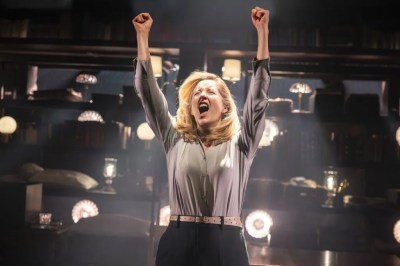
Westfeldt’s Julie, endlessly positive despite numerous, heartbreaking setbacks, is a nice contrast to the needling and bickering of a typical family Christmas. It is a sweet portrayal, and one that shines particularly in the second half when the reality of Julie’s situation, twenty years later, becomes clear. Westfeldt’s delivery is deceptively sweet, hinting at a troubled childhood while also reflecting on a life lived by the end of the piece. Her lengthy monologue, towards the play’s conclusion, is a neat opportunity to hear the real Julie, something the script robs us of in a brisk conclusion to the first half, which Westfeldt delivers with aplomb.
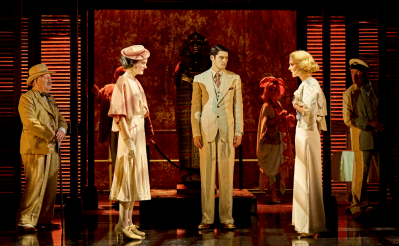
It is the matter-of-fact nature of Greenberg’s dialogue that makes it so authentic, and also so instantly engaging. Discussions rush through pregnancies, infidelities and even a death amid the AIDS crisis that gripped New York in the 80s, with a refreshing sense of normalcy in expression that makes us feel like flies on the wall to this family, grappling with seismic shifts in it. This is aided by James Cotterill’s brilliant set design, aided by the revolve, that quickly snaps us from location to location in Julie and Ben’s grand house, while also aiding the layered nature of Greenberg’s dialogue.
By the bittersweet conclusion, The Assembled Parties shines as a terrific unpacking of a complex family dealing with complex family situations. It is a funny, heartfelt and biting piece, effectively directed by Blanche McIntyre in this lavish production.



 Read About Stuff | London Theatre Reviews & Culture