Did this make my top 50 of 2025? Check out Read About Stuff’s Favourite 50 Shows of 2025.
For Mary Page Marlowe, life is a sequence of missteps, moments of defiance, and quiet collapses. Tracy Letts’s play, revived at the Old Vic, dissects one woman’s existence across five versions of herself, tracing the self-destructive heartbeat of a life lived half in pursuit of control, half in surrender to chaos. Alcohol, sex, and bad choices form the crux of Mary’s undoing, but Letts’s writing refuses to condemn. Instead, he paints a portrait of a woman caught between recklessness and regret, always human, never simple.
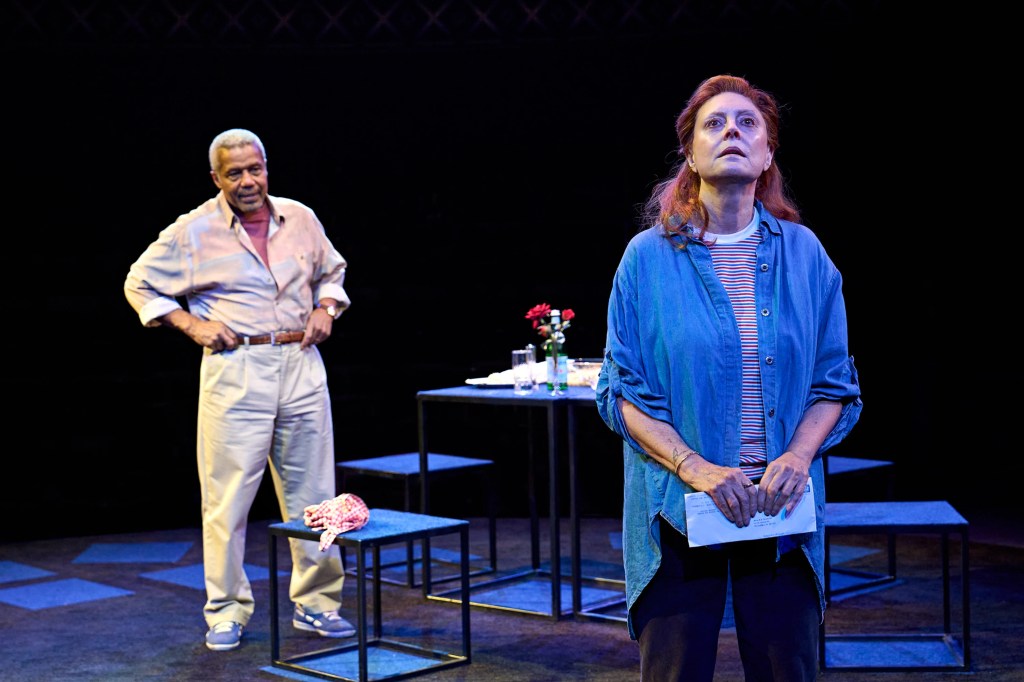
The Old Vic’s decision to stage the production in the round proves inspired. Audiences sit in close orbit around Mary’s disjointed life, pulled into her moments of tenderness and turmoil with uncomfortable intimacy. The configuration mirrors the script’s structure, with her story turning in circles, not lines. It makes for a raw and immediate experience, as though Mary herself is under gentle interrogation from every seat in the house.
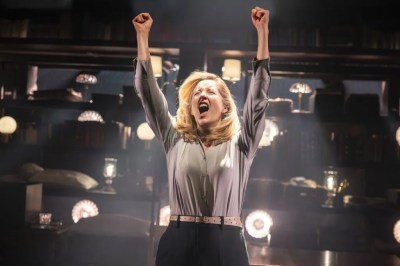
Susan Sarandon and Andrea Riseborough lead the ensemble with composure and precision. Sarandon’s older Mary is all restraint, her stillness heavy with memory and fatigue. Riseborough captures the younger woman’s volatile charm, her moments of rebellion laced with the desperation of someone already aware of the ruin ahead. Alongside them, Alisha Weir, Eleanor Worthington-Cox, and Rosy McEwen each inhabit fragments of Mary’s life with conviction, together shaping a single, multifaceted performance. Weir offers innocence clouded by uncertainty, Worthington-Cox brings emotional volatility to a teenage Mary teetering on collapse, and McEwen bridges youth and disillusion with raw vulnerability. Together, the five create a seamless continuum of one flawed, fascinating woman.
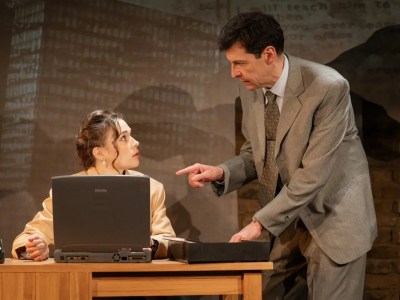
Letts threads men through Mary’s story as fleeting presences, husbands, lovers, absences, each reflecting her instability rather than grounding it. Their impermanence serves the narrative well, allowing Mary to remain the gravitational centre of her own destruction. The non-chronological structure complements this, encouraging audiences to piece together her life from the inside out. Slowly, we learn not just what happened to Mary, but why.
Mary’s relationship with her daughter Wendy, played by Clare Hughes, offers a further window into her decline. Hughes’s performance is a touch shouty, but her frustration feels rooted in the decades of damage Mary’s behaviour has caused. Their confrontations spotlight the ripple effect of Mary’s self-corrosion, showing the pain inflicted on those orbiting her chaos. Still, each scene between mother and daughter begins to blur, circling the same emotional territory without deepening it. The repetition makes these moments feel more illustrative than revelatory.
Yet, for all its intelligence and sensitivity, the production struggles to maintain rhythm. The frequent blackouts and scene changes, while necessary to navigate five decades and five Marys, break the spell too often. Each reset interrupts emotional flow, leaving the piece feeling more fragmented than fluid. When the lights finally steady for the final scene, the resolution comes with a whimper rather than a punch. Letts’s choice to resist neat closure feels true to life, but the result is strangely inert, offering contemplation instead of catharsis.
Still, Mary Page Marlowe remains a compelling study of imperfection. Beautifully acted and sensitively staged, it captures the ache of a life lived too hard and too fast. It may falter in momentum and finish without flourish, but in its best moments, it finds something quietly profound, a reflection of the mess, mystery, and melancholy of simply being human.



 Read About Stuff | London Theatre Reviews & Culture