Did this make my top 50 of 2025? Check out Read About Stuff’s Favourite 50 Shows of 2025.
In Elizabethan England, words could get you killed. In Born With Teeth, they might also make you unforgettable. Liz Duffy Adams’ taut, two-hander — revived here under Daniel Evans’ bold direction — traps Christopher Marlowe and William Shakespeare in a single candlelit room and forces them to write together. What follows is less a partnership than a power struggle: two men circling each other with wit, ambition, and fear, as art, politics, and desire blur fatally at the edges.
The premise is tense. Marlowe, already the crown’s favourite and the city’s most infamous playwright, is also working as a spy — a double life that makes him as dangerous as he is brilliant. He is a man who trades in secrets, using his sexuality as a weapon: to seduce, to manipulate, to blackmail. Shakespeare, meanwhile, is still a relative nobody, cautious but sharp, eager for the chance to learn from genius — or perhaps to surpass it. Forced together on a royal commission, the two are drawn into a web of creative rivalry and mutual fascination. Outside the room, England seethes with paranoia and treason. Inside it, the real danger is each other. The dialogue-heavy middle section wobbles slightly, losing a little of the opening’s taut energy, but nevertheless the fraught relationship has enough in it to rescue the play from its slower, lingering, moments.
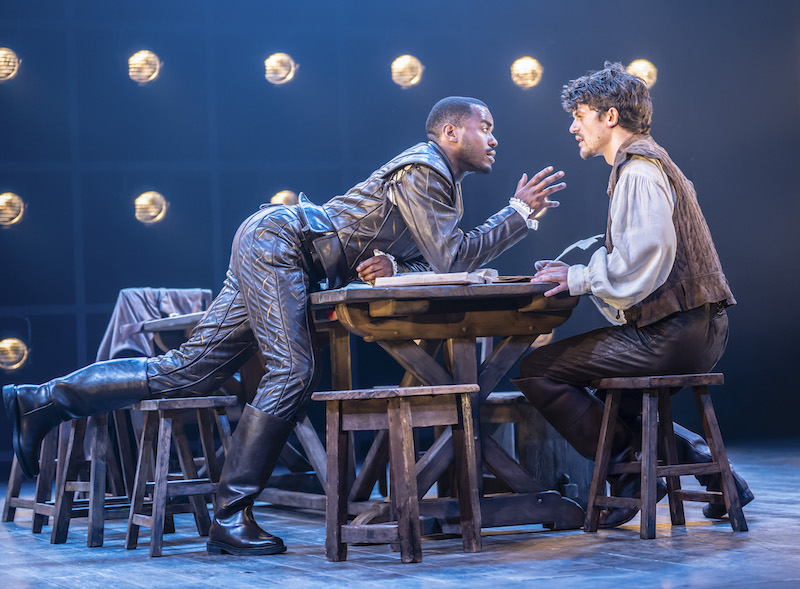
Ncuti Gatwa’s Marlowe is mesmerising: a performance of pure voltage. He prowls the stage with electric charisma, flamboyant and ruthless, his sharp tongue flicking between seduction and threat. Gatwa makes it clear that Marlowe’s intelligence is both his armour and his curse — every joke and gesture a deflection from the peril he embodies. There is something modern in his performance: a man who weaponises charm as easily as he wields a pen. His laughter lands like a dare; his silences, like traps.
Opposite him, Edward Bluemel’s Shakespeare begins tentative, almost deferential — a man so used to watching from the wings that he struggles to claim the stage. But across the play’s three acts, Bluemel quietly turns the tide. His Shakespeare grows in confidence and conviction, gradually matching Marlowe’s fire with something cooler but just as potent: resolve. By the closing moments, he is no longer the lesser of the two men, with his final act as dangerous and as impacting as some of his writing’s greatest villains.
The attraction between the two men simmers from their first exchange, a charge that Gatwa and Bluemel play with exquisite control. Their chemistry builds through glances, verbal feints, and shifting proximity until, suddenly, it bursts — a playful, dangerous, intoxicating tryst that feels both spontaneous and inevitable. Evans lets the moment hit like a spark catching dry parchment. It is a scene powered entirely by the actors’ skill: Gatwa’s teasing volatility colliding with Bluemel’s repressed intensity, the result thrilling, unnerving, and utterly magnetic. Their first embrace becomes a turning point — the instant rivalry turns to risk, and admiration to something much harder to name.
The set design captures that intensity perfectly. A single wooden table and a few stools sit centre stage, surrounded by hundreds of lightbulbs that line the perimeter. The effect is both stark and claustrophobic — as though the characters are trapped in a ring of scrutiny, their every word and movement exposed. The table becomes a battleground, a place to encircle and confront, to write and to destroy. Evans’ use of video projections punctuates the action: opening the play and closing two of its three parts with startling power. The image of a screaming Marlowe, distorted and magnified, is particularly haunting — a violent reminder of how close brilliance can come to collapse. It is just a shame there is not more of this visual daring throughout; when Evans leans into the style, the production becomes electric.
For those aware of Marlowe’s historical fate, the final moments of the play carry an almost unbearable dread. The violence that erupts feels both inevitable and horrific, the culmination of all the tension that has been meticulously built. Gatwa and Bluemel’s performances make the impact immediate and heart-stopping — Marlowe’s danger is literal, the stakes painfully real, and the aftermath leaves Shakespeare alone on stage, the weight of survival and loss pressing down. It is a final sequence that haunts, long after the lights fade.
Born With Teeth is both intimate and explosive — a study of genius, danger and desire that leaves its mark. It does not just draw blood. It knows exactly where to bite.



 Read About Stuff | London Theatre Reviews & Culture