This review was originally written for The Reviews Hub: https://www.thereviewshub.com/the-woman-park-theatre-london/
Did this make my top 50 of 2025? Check out Read About Stuff’s Favourite 50 Shows of 2025.
After landing her first playwriting hit, writer M is at the peak of her writing powers. Yet after the birth of two children in quick succession, and the pressures of motherhood wrestling with her own individual desires, M’s life threatens to come to a shuddering halt in this fierce, urgent show about the roles society expects women to play and the potential catastrophe when you lose your sense of self.
It is a play as funny as it is stark. Writer Jane Upton weaves humour well into the metatheatre. In the programme, Upton remarks that the piece was inspired by a real-life encounter with an ex-boyfriend, and while lifted from a personal anecdote, the play never becomes so autobiographical that it does not appeal.
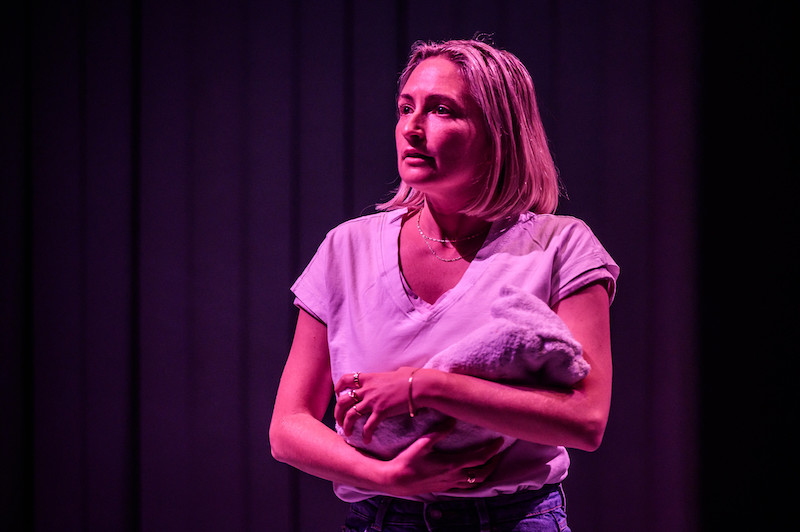
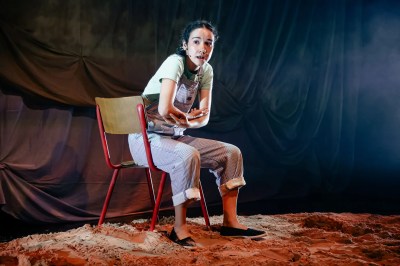
As the play’s protagonist, M grapples with different stages of motherhood, including the trauma of childbirth, the stalling of a promising career, and the devastating impact the shift in hormones can have on a woman’s libido and her relationships around her. This is laid out quite quickly during the play’s odd and shocking opening, with M standing cradling her newborn child in a pristine white gown before turning to reveal a shocking bloody stain. The piece packs a lot into its 95-minute run time, and Angharad Jones’ direction is unflinching in its portrayal of the significant impact motherhood, and the changes physically, emotionally and socially it triggers, has upon M.
As M, Lizzy Watts’ full-throttle performance is gripping. Watts blends the various emotions vying for M’s attention in this portrayal, performing M’s gradual and devastating erosion of self before eventually finding a sense of identity with aplomb. Watts’ comic timing is also evident here, delivering Upton’s witty writing with quick energy that keeps the piece, and M’s volatile existence, moving. Upton’s writing encourages us to view M from all angles, as an aspiring but low on confidence writer, as a fearful mother and as a woman on the cusp of a breakdown. Yet despite all of these emotions, which should exclusively evoke pity, Watts also finds room to explore M’s slight selfishness, too. It is a complex role to play, yet one that Watts makes look easy.
Aside from Watts, who sticks exclusively as M, the remaining trio multi-role as numerous individuals that make up M’s increasingly chaotic and disparate existence, representing her myriad of lives, from writer to wife and from new mother to best friend, all rolled into one. Jamie-Rose Monk is the multitude of women M encounters, each with their own view on motherhood, being a woman and how M should behave. Monk shifts from best friend, to midwife, to agent and even to M’s mother, but does well to weave a sense of continuity between all characters in the sense that these women all hold M to a standard that M struggles to reach, and given this is a play that really pours out M’s thoughts, a standard M believes she should meet herself. Monk’s more devastating portrayal, though, is as Julie, the mother of a child who sadly passes while M’s second child is in hospital too. Upton’s writing really succeeds here, enabling the heartbreaking loss to breathe, while also looking at its long-term consequences for the mother who feels they are no longer playing that role.
Furthermore, André Squire, largely though not exclusively M’s husband, is strong in the complex male roles that follow M too. The relationship between M and her husband focuses mainly on its breakdown following M’s loss of sexual desire, no longer feeling attractive after childbirth and after over a decade with the same man who has seen her warts and all. Squire’s portrayal of the husband grows in impact, especially by the play’s climax, when the couple face their child’s illness head-on, with Upton giving just enough stage-time to the male perspective in a play that really delves deeply into M as a woman. Meanwhile, Josh Goulding, a little underused, takes on the more stereotypical male roles from scumbag ex who offers M a bunk up in his van through to theatre producer who scoffs at a play about motherhood, instead wanting a play about babies only if they have superpowers. It all gets a bit absurd, but, as a sum of components, messy parts, it works.
The crude humour, when M’s writing is at its rawest and arguably its worst, works well to portray a woman on the edge of oblivion, but this is particularly impactful when contrasted with the play’s bleaker, more desperate moments, such as M’s painfully personal letter she writes to herself. Given the stark content the play covers, it is a remarkable feat just how funny the play is, and while it is a work that focuses closely on the loss of libido for a woman who has lost the love for herself, with sex, and its various acts, forming the punchline frequently, the piece never goes so far as to lose sight of its deeper ideas about motherhood and, more broadly, womanhood.
Upton’s script is obvious in its metatheatre approach, exposed almost immediately when M rifts an opening number using the backing track from Hamilton’s My Shot. The reason for this is clarified in a later scene, but it is just one example of the numerous play-within-a-play methods that adds intriguing layers to M’s story. This is compounded by a clever use of lighting (Lily Woodford) and projection (Matt Powell) during sporadic moments, seen particularly in fraught dialogue, when M ‘redrafts’ lines, with performers repeating two or three times until it is ‘right’. This poses an interesting question about M’s authenticity, forcing audiences to question what is and what is not real, but more deeply, it furthers the fixation upon small details that reflect M’s sense of entrapment by her motherhood role.
‘Who wants to watch a play about the struggles of motherhood?’, M is asked by one of her interrogating prospective producers. Based on this production, the urgency for such a story is utterly compelling, and what results is a bold, provocative piece of theatre.






 Read About Stuff | London Theatre Reviews & Culture