
Did this make my top 50 of 2025? Check out Read About Stuff’s Favourite 50 Shows of 2025.
Creating any art can evoke a sense of frustration and pressure, particularly if you are at the peak of your artistic powers. It is this intense pressure, and the eroding consequences it can have, that are so grippingly portrayed in Stereophonic.
The play, renowned for its unprecedented volume of Tony Award nominations while on Broadway, centres around a fictitious 70s rock band locked for months in a fraught recording studio working on their hotly anticipated album. Although the band itself is imaginary, it is believed that writer David Adjmi has based this piece upon the similarly difficult completion of Fleetwood Mac’s iconic 1977 album Rumours.
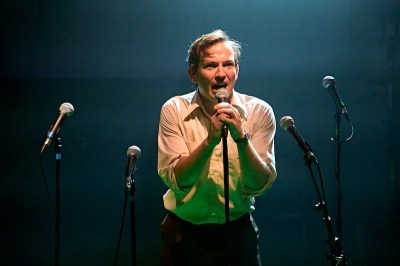
What follows is a gripping and excruciating character study where all five band members slowly erode, changing for the worse, as the pressure upon them takes hold. The band are spearheaded by ultra-intense frontman Peter (Jack Riddiford), whose desire for creative control pushes all those around him to their limits. Riddiford’s Peter, decked out in 70s gear with the apt rockstar sunglasses to boot, is completely loathsome, especially in his treatment of the ambitious Diana (Lucy Karczewski).
Though in truth, none of the characters are in any way completely likeable, and that is the brilliance of the piece. Karczewski’s Diana is naive and vulnerable to begin with, but hardened by her experiences in the recording studio, the character’s selfishness and ruthlessness prove just as divisive.
Alongside the pair are the permanently stoned Reg (Zachary Hart) and the deadly serious Holly (Nia Towle). Hart’s Reg, on the constant hunt for the bag of cocaine stashed somewhere in the studio, is a not very subtle reminder of the drug-fuelled creativity of the era. At the same time, Towle’s Holly is determined to escape her husband’s corrosive drug addiction. Their on-off relationship is just as problematic for the band as Peter and Diane’s, adding more fuel to the already burning catastrophe that is unfolding.
Making up the quintet is erratic drummer Simon (Chris Stack). Although a little too Matt Berry at times, Stack’s Simon is at its strongest, as a character, when the pressures of keeping the band in time and in check get too much. Simon is the band’s elder statesman, before fame took hold, and his pining for the simple family life which the experience costs him contrasts well with the drug habits, illicit sex and alcoholism elsewhere in the band.
By the end, it feels like a complete miracle that the band manage to get anything out at all, and this is thanks to Grover (Eli Gelb) and Charlie (Andrew R. Butler). The pair, as the producer and sound mixer respectively, hold the studio together by what feels like thin electrical tape, yet also serve as commentators to the band’s eruption as it unfolds.
It is a play that thrives in design as well as writing. The piece includes a multitude of brilliant original songs, penned by Arcade Fire’s Will Butler, and these have a cadence that quickly evokes the 70s style. It also helps enormously that this piece boasts an exceptionally talented set of musicians as its cast, not only demonstrating the ability to play in time, but more challengingly, play deliberately out of time too when things derail. Once the notes fall into place, however, it is impossible not to be swept up in the charm the band produces, evoked so superbly by the performers.
Furthermore, David Zinn’s set design blends well with Daniel Aukin’s direction to throw us into the creative hub. The decision to separate upstage behind soundproof glass is a cute touch. It enables us to see conversations unfold yet not hear them, a tantalising design choice that only adds to the bubbling tension throughout the piece.
Although the quest for the hit album drags the band members down to irreversible depths, ironically, this tale serves up a smash hit. Where Stereophonic thrives best is in its brutal presentation of a band completely disintegrating, comprising five members who all lack redeeming features, and while these painful conversations should be too awful to watch, the three-hour run time more than fizzes by with a rhythm that, just like in the piece’s most magical musical moments, hits the right notes.






 Read About Stuff | London Theatre Reviews & Culture