This review was originally written for The Reviews Hub: https://www.thereviewshub.com/the-party-girls-marlowe-theatre-canterbury/
Did this make my top 50 of 2025? Check out Read About Stuff’s Favourite 50 Shows of 2025.
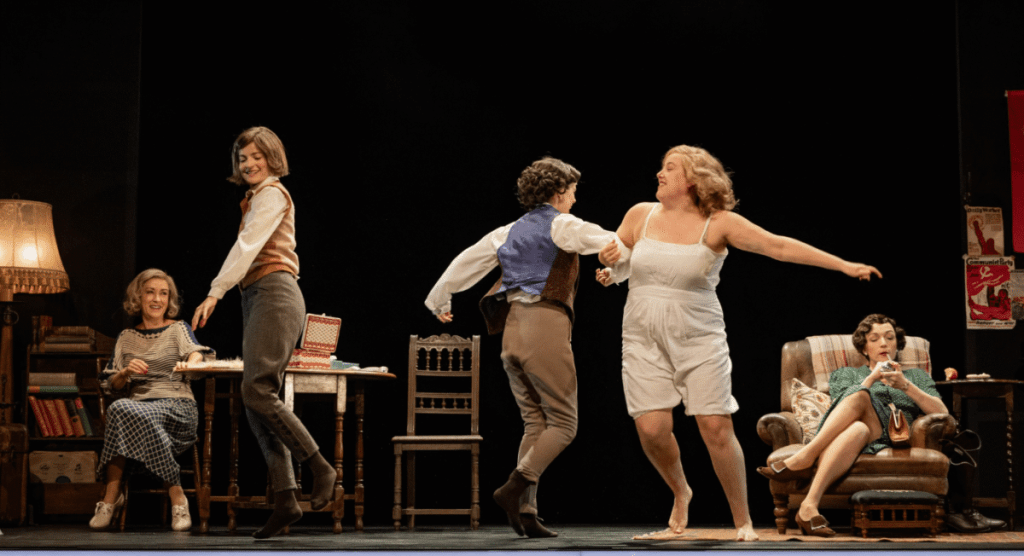
Swept up in scandal upon scandal, the Mitford sisters are once again thrust into centre stage in this exposing and fascinating new drama, The Party Girls, Amy Rosenthal’s new production in a joint venture with the Marlowe Theatre.
The play is split into three time periods, all interchanging across the production. Launching in the middle of World War Two, the piece then shifts a decade earlier, and two decades later, showing how the ravages of war, and its propaganda, gradually swayed the impressionable Mitford sisters. It is a piece that reflects its time and does not shy away from its brutality. Characters like Unity, intoxicated with Nazi ideology, swear allegiance to Hitler and treat the Third Reich leader almost as a boy band up. Shocking and fascinating in equal measure, the contrast between Unity and Diana (later British fascist Oswald Mosley’s wife), with sister Jessica ‘Decca’, a staunch communist sympathiser, literally and metaphorically splits the aristocratic family in two.
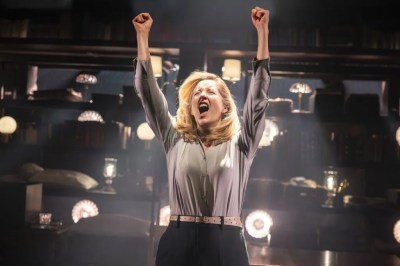
While the piece does centre around the sisters, it does so mostly through the eyes of Decca (Emma Noakes), who grows increasingly estranged from her sisters. Noakes’ portrayal of Decca, struggling to find herself heard with differing viewpoints from her sisters, captures this frustration well. Noakes does well to create an empowered Decca, growing in identity yet tapering it with a sense of vulnerability that even in old age provides a feeling that Decca lacks belonging. It is a bit odd that while Decca rightly criticises the cruelties of views held by sisters Unity and Diana, her own communist views, underpinned by a love of Lenin and Stalin, are never truly acknowledged in anything other than admiration.
Nevertheless, Decca is contrasted well with the other sisters. Kirsty Besterman’s novelist Nancy cuts with precision using witty metaphors and similes, with Besterman’s classy portrayal of the writer apt. Meanwhile, Flora Spencer-Longhurst’s Debo, a little sidelined, is energetic and provides a good injection of youthful energy, particularly during the play’s flashback scenes. In addition, Elisabeth Dermot Walsh and Ell Potter, Diana and Unity Mitford respectively, are stark as the pair who are swept up in fascist ideology. Walsh’s Diana cuts a stoic figure in later scenes, refusing to acknowledge the horrors of the Holocaust in a terrifyingly apathetic exchange, while Potter’s Unity, gullibly carried away by her charmed view of Hitler, results in devastation. It is in Potter’s portrayal of Unity that one truly sees the impact of such ideology, going from a bubbly, excitable, young woman to a murderous, hateful, desperate figure.
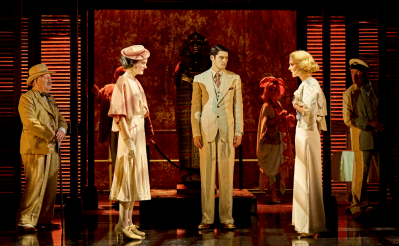
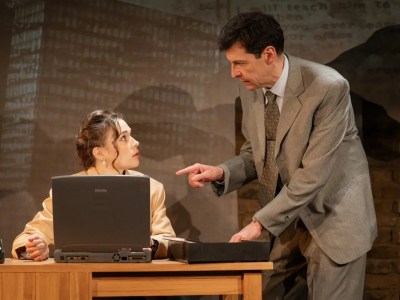
Simon Kenny’s design equally helps to evoke a family polarised by ideological opinion. It is a little obvious, with the drawing room split down the middle with Nazi left on the left and Communist symbols on the right, but it does work in quickly establishing the two views of the Mitford sisters. It also shifts nicely, from the quaint aristocratic house and plush French interior in later scenes to the darker, more pragmatic government office scenes for Decca in her war working scenes.
It is a script, though, that makes some choices that disrupt the play’s momentum. A little too over-reliant on knowing the ins and outs of the Mitford dynamic, the play’s exposition is a little tricky to follow for the uninitiated, where pet names, nicknames and first names are used interchangeably. Furthermore, while the decision to switch between pre- and post-war sheds clear light on the stark impacts the global catastrophe had on one family, the inclusion of Decca’s life in America and her burgeoning love affair with American-Hungarian Jew Bob is a little shallow, lacking the vigour and bite of the scenes between the sisters. The play is far more interesting when the girls’ dynamics are explored, while this love story causes the piece to be a little bloated.
Nevertheless, The Party Girls does a terrific job of giving time to dig well into the complex lives of each Mitford sister. Its stark focus on Unity and Diana’s antisemitism, brutal in delivery, in particular feels timely, shining a clear spotlight on a fascinating family, defined by such extremist beliefs. The play is unflinching in exposing the horrifying political beliefs some of them held, but also engrossing in exploring a family changed by the divisions caused by uncompromisable ideological differences. Shocking and surprisingly funny in places, it is a slick character study of those swept up by their starkest and darkest desires.







 Read About Stuff | London Theatre Reviews & Culture