
This review was originally written for The Reviews Hub: https://www.thereviewshub.com/lost-property-camden-fringe-2025-etcetera-theatre/
Did this make my top 50 of 2025? Check out Read About Stuff’s Favourite 50 Shows of 2025.
Alice has lost something, or is there more to it? That’s the premise of Lost Property, a thought-provoking monologue.
We meet Alice while swaying on the tram, at a crossroads in her life, in the doldrums, unemployed and seemingly lacking in purpose. Alice’s disappeared object is not what you would expect; it is her vagina. Stuck on a painfully slow tram ride in metropolitan Australia, Alice’s desperate attempts to find her ‘self’ are compounded by her desire, initially unclear as to why, to avoid the gaze of Bianca, also on her tram.
What initially starts as a fun and humorous look at the trials and tribulations of a woman with a lost libido and failing personal life, Lost Property takes a more serious tone as the real reasons for Alice’s vaginal disappearance become clear. The monologue interweaves Alice’s attempts at therapy, and her initial sexual awakening with a brutal work party, and the events she witnesses which occurred there, that continue to haunt her subconsciously.
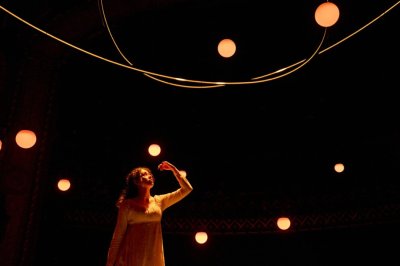
This is a well-balanced production that strikes a good balance of when to be funny, and importantly, when not to. When Dunn suddenly appears centre stage with a hat shaped like a vagina, it is impossible not to find the absurdity amusing, but this is well contrasted with Alice’s horrifying flashbacks as the piece comes to its conclusion. Dunn controls this successfully, initially a little too frantic, but arrests this well in moments where Alice’s piercing eyes are enough to evoke the unfolding scene’s true horror.
This is a play that is as much about guilt and forgiveness as it is a serious take on sexual assault. Dunn and co-writer Tuia Suter’s script provides a not commonly trodden insight to such stories, thinking more about the impact upon bystanders and witnesses, rather than the victim and perpetrator. It is one that mostly lands well, though the play’s ending does feel a little too neat, eager perhaps to end the more serious second half on a lighter note, but this is to the play’s and its message, detriment. The humour, too, is a little too crass in places and a little too reliant on Australian culture, which does not always translate well to its London audience.
Nevertheless, Dunn’s energetic and powerful performance delivers with aplomb and impactfully conveys the piece’s urgent and timely values. While the premise focuses on something lost, what Alice gains by the end of her tram journey leaves a lasting impression.





 Read About Stuff | London Theatre Reviews & Culture