This review was originally written for The Reviews Hub: https://www.thereviewshub.com/boys-from-the-blackstuff-marlowe-theatre-canterbury/
Did this make my top 50 of 2025? Check out Read About Stuff’s Favourite 50 Shows of 2025.
It has been over 40 years since Alan Bleasdale’s hit TV series aired on BBC Two, focusing on the lives, trials and tribulations of working-class men and women in Liverpool, savaged by economic depression and mass unemployment. Almost half a century later, playwright James Graham, well-versed in ‘state of the nation’ style scripts, has revisited Bleasdale’s work with this gripping and heartfelt stage adaptation.
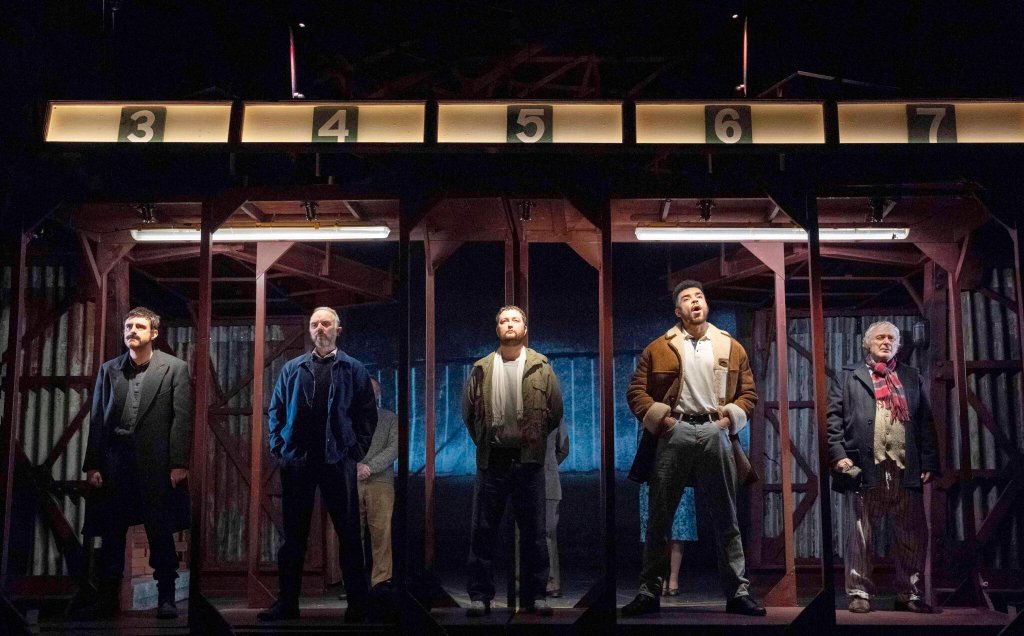
Alan Bleasdale’s Boys From The Blackstuff follows six unemployed men scrambling for work, having been laid off from their road-laying jobs previously after making some wrong choices. These choices haunt the six, who now find themselves cast adrift from society, eager for work but unable to find any, while being scrutinised by the law for benefit fraud, while taking any ‘cash-in-hand’ jobs they can find. Graham’s writing style thrives in this bleak, but very human, setting. Lifting heavily from the source material, Graham’s script maintains the human element well, focusing exclusively on the anguish and anxiety unemployment has upon the men, particularly the impact it has upon their masculinity, their pride dented by their jobless state. Despite its 80s setting, the piece maintains a sense of timelessness with easily identifiable characters. As we witness each man gradually ground down by his situation, it is impossible not to empathise with the show’s characters.
It is a show with a tight, hard-working cast who shine a spotlight on the characters’ struggles superbly. George Caple (Chrissie), Jurell Carter (Loggo), Ged McKenna (George), Mark Womack (Dixie) and Reiss Barber (Snowy) all bring to their roles a clear identity, all men broken in their own way by their own situation, desperate for purpose, and for a pay packet. There is a quick sense of camaraderie built between the men that the performers capture well, even when these relationships break down, and it is hard not to feel anguished in the audience as these men bare their souls.
Caple’s Chrissie, the eternal nice guy, is shocking when this facade suddenly drops, while Womack’s Dixie, a man used to responsibility but still gripped with anger at his friends’ betrayal, is performed with subtlety and a stoic, and moving composure. Barber’s Snowy and Carter’s Loggo empahsise characters who wish to escape the grips of unemployment, even if that evokes tragedy, while McKenna’s aged George, a docker worn down by the passage of time and struggling with comprehending the changes around him, provides a pillar of calmness and wisdom for the other men, in a beautiful portrayal.
The standout performer, though, is Jay Johnson, who has the unenviable task of taking on the piece’s iconic role, Yosser. Johnson’s delivery perfectly captures a man whose identity has been eroded, corrupted, by his internalised sense of worthlessness after seeing his family life, and his working life, collapse. Yosser bears the brunt of the blame for much of the other characters’ misfortune, seemingly tolerated but not enjoyed by the others, and while initially Yosser provides some lighter moments, these fade away during a devastating second half, with one particular slow-motion scene, completely enthralling.
Amy Jane Cook’s design is utilised well, blending the opportunity for projections which enhance some of the more chaotic or emotive scenes, with harsh, industrial landscapes. The decision to have two suspended crane-type machines gradually moving closer, towering over the men, creates a sense of claustrophobia that mimics the stifling conditions they find themselves in, supported well by the bleak surroundings of corrugated iron. There are quick scene changes to the dole office, pub and houses, but it is the docks that are the most striking and most despairing.
The production is a bleak and brutal insight into the real-life impact of Thatcher’s Britain upon the working classes of Liverpool. While the Iron Lady only appears fleetingly, projected during the play’s opening, her presence lingers in the stifling economic conditions those in the city find themselves in. This is nodded to when Dixie reflects that the reason for their downturn in fortunes is because they are on the ‘wrong side’, which he clarifies is relating to shipping routes, but could quite easily be a politically grounded statement. It is a clever touch, though, by Graham not to make the piece too political. It is much better when it focuses on the human impact of such conservative policies, enhancing the play’s absorbing story, rather than when bogged down in dole office interviews.
Armed with gripping and emotive performances, despite the source material’s age, this is a fresh and brutal take on a piece of recent British history which still starkly resonates today.








 Read About Stuff | London Theatre Reviews & Culture