This review was originally written for The Reviews Hub: https://www.thereviewshub.com/our-cosmic-dust-park-theatre-london/
Did this make my top 50 of 2025? Check out Read About Stuff’s Favourite 50 Shows of 2025.
What happens to us when we die? It is a common question that numerous stage plays have tackled, yet this stunningly theatrical production, Our Cosmic Dust, feels like a fresh and heartfelt piece that lasts long in the memory afterwards.
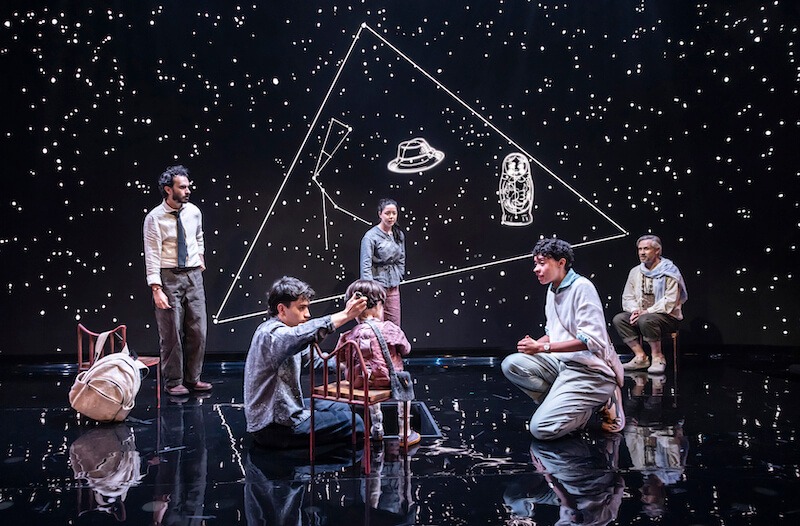
Our Cosmic Dust, making its English-language debut, comes from Japanese writer Michinari Ozawa, and blends puppetry, impressive visuals and a poignant script to explore the concept of death through the character of Shotaro. Shotaro (Hiroki Berrecloth), a small schoolboy struggling to come to terms with the death of his father, sets off on a journey to discover where his father has gone, believing that he should be living in the stars, but has not reached the galaxy yet. Meeting quirky individuals on the way, Shotaro is tracked down by his mother Yoko (Millie Hikasa), desperate to reconnect with her increasingly distant, and still mourning, son. What follows is a rumination for all the characters on death, the afterlife, and where our essence goes to once we pass, but its viewpoint, not just through Shotaro’s eyes but through those he interacts with, is what makes this a poignant and special piece.
Berrecloth’s portrayal of Shotaro blends physicality with puppetry, and it is hard to take your eyes off this captivating performance. Berrecloth’s gentle control of Shotaro’s delicate puppet is genuinely moving, capturing all of his moods from his inquisitive probing of nurse Tara (Nina Bowers) to his quieter, mournful state during a later scene in a planetarium. It is a refreshing take for Shotaro to be so inquisitive, despite his young age, about death, and the play’s decision to see death through his eyes, more intriguingly and innocently, aids us to question our own beliefs too.
Park Theatre’s space works well to bring Shotaro’s puppet close to audience members, and Berrecloth’s control of Shotaro’s puppet brings the vulnerable character to life for the audience. In times where puppetry on stage often is big and bold (War Horse, Life of Pi, My Neighbour Totoro), the quiet and gentle touch is welcomed here, and the piece thrives as a result. This is particularly striking in the play’s final scene, where Berrecloth, playing in this moment Shotaro’s father, and Shotaro share the stage. It is a powerful moment that Ozawa allows to breathe, gorgeously staged to give father and son a special, timeless moment, representing the heartbreaking loss, but also the everlasting bond between two individuals despite death’s separation.
Hikasa’s Yoko successfully conveys a grieving wife and struggling mother trying to keep herself and her son, emotionally and physically, together. Amid the chaos of the odd characters, Shotaro’s story causes us to meet, it is the quiet, pained Yoko that provides a nice contrast to the rest of the performance. Hikasa’s portrayal of raw grief is clear to see, and Hikasa does well to force audiences to become frustrated with the character at times, just like those on stage, as Yoko attempts, frustratedly, to get through to her anguished son. Yoko’s character is a nice inclusion by Ozawa to represent a more typical viewpoint on grief; the tears Yoko sheds resonate with everyone who has lost someone dear, but it is a also a useful tool in helping the writer to convey that grief, and the ability to understand and compute the death of such a pivotal figure, is multi-faceted.
Alongside Berrecloth and Hikasa are Bowers, Hari Mackinnon, and Ian Hallard. They initially portray Shotaro’s spiralling thoughts before staying more consistently as Tara, Alastair, and Orion, respectively. It is through these three that the piece’s charm shines, as while each character’s interaction with Shotaro helps Yoko to track down her son, they also provide uniquely personal insights into their grief. Bowers’ energetic Tara is struggling to come to terms with the death of her mother, while Mackinnon’s Alastair is wrestling with the death of his beloved pet dog. Both characters are quite obvious in their portrayal, but these allow for a blend of humour as well as heartfelt moments that the piece needs to breathe. Furthermore, Hallard’s amusing Orion, the planetarium owner, initially wacky and funny, but whose dementia-suffering husband has died, is used as a source of comfort for Yoko and Shotaro.
It is, though, the theatricality of the production that makes Our Cosmic Dust so special. While it is easy to be struck by the brilliance of Berrecloth’s control of Shotaro’s puppet, especially during the aforementioned chase scenes which uses the entire cast to depict Shotaro’s desperate sprints, it is also in the stunning video and lighting design (Eika Shimbo and Jodie Underwood respectively) that this production shines. Right from the start, the space is filled with sparkingly stars, capturing Shotaro’s wonder and desperation to find his father’s spirit, but the decision to then move the design into a tamer, black and white display is a strong choice, initially representing Shotaro’s frenetic scribbles and drawings, before bursting into colour by the play’s conclusion in a beautiful and moving final scene that it is hard not to shed a tear at. The design helps to evoke the same feeling of warmth that many Japanese anime pieces do, and does so well. In a piece all about death, Our Cosmic Dust relies heavily upon the heart to bring a sense of warmth, and the design combines effectively with the cast to achieve this.
The play is full of absurd moments that work effectively to bring life and energy into a piece that is all about death. Reducing a loved one to a shiny silver tooth, creating constellations out of Russian Dolls and ramen bowls, and frantic chases all, out of context, sound bizarre, but in this situation work perfectly to capture the essence of the show. Our Cosmic Dust is an utterly beautiful, heartwarming and heart-wrenching piece. Although not originally in English, this is a triumphant piece whose message is certainly not lost in translation.
It is impossible not to want to scoop Shotaro up yourself and give him a hug by the end, but the real beauty is in the play’s delicate storytelling on death and its longevity. A moving and evocative piece of theatre.









 Read About Stuff | London Theatre Reviews & Culture