This review was originally written for The Reviews Hub: https://www.thereviewshub.com/the-crucible-shakespeares-globe-london/
Did this make my top 50 of 2025? Check out Read About Stuff’s Favourite 50 Shows of 2025.
‘What is John Proctor? ’ cries Arthur Miller’s doomed protagonist John Proctor, staring reputational ruin in the face, as the American playwright’s Salem Witch Trials-inspired McCarthyism critique, The Crucible, has new life breathed into it at Shakespeare’s Globe.
The Crucible, which uses the infamous witch trials to criticise the relentless hunt for Communist sympathisers by Senator Joseph McCarthy, focuses upon the growing hysteria in Salem following accusations of witchcraft by the conniving Abigail Williams (Hannah Saxby), whose allegations sparks mass panic, and murder of innocent women, in this otherwise sleepy, rural, town. As John Proctor fights for his name at the play’s conclusion, questioning his own sense of self, the blend between what is right and what is wrong is lost on those in Salem, reminding and warning those watching not to lose sight of this eternal debate themselves.
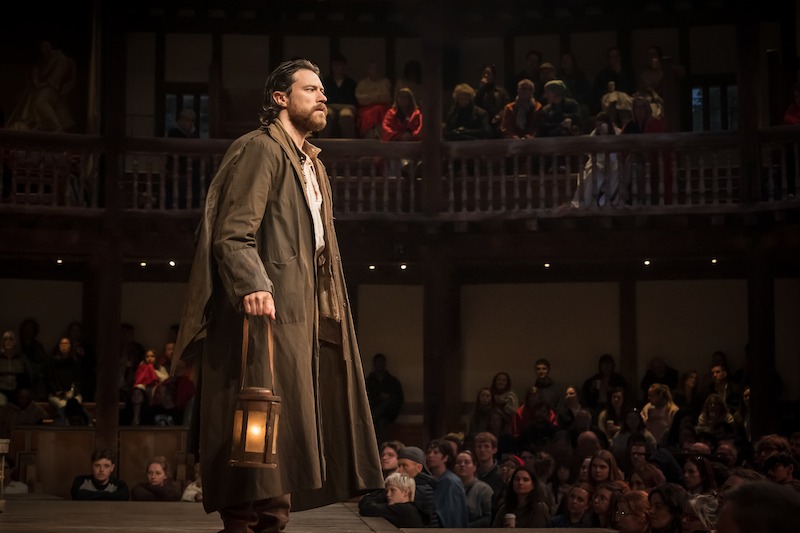
Ola Ince’s version shifts the production from its traditional American base to a more rural English setting, with the programme nodding to the brutal witch trials in East Anglia around the same time and into the 17th century. As Miller’s drama unfolds, and as more and more innocent women are put to death, the spotlight turns to John Proctor (Gavin Drea), whose defiance and demand for recognition and retribution threaten his own life.
Ince’s staging of this American classic thrives in the Globe’s theatre. The decision to move the performers around in various platforms successfully evokes the chaos of a witch trial, while the theatre’s distinct 16th-century setting helps to quickly immerse the audience in the trial itself. The towering tiers of the theatre’s galleries loom over Proctor as he reaches his fate, and it is easy to feel transported into the brutal, discriminatory environment of such ‘courtrooms’.
This staging of The Crucible also includes a pre-show, which again uses the theatre’s promenade-style configuration. The theatre is scattered with all sorts of townspeople crippled by fear of witchcraft, from the sobbing accused, whose haunting cries deafen the theatre upon first entry, to the terrified villagers pointing guns at the audience seeking out the next supposed witch. With this pre-show, it is impossible not to be swept up, particularly if you are one of the theatre’s ‘groundlings’, in the mad panic that sweeps through the play’s characters. Furthermore, Ince employs the Globe’s roof-room, known as ‘The Heavens’, ironically, packing into the small space the numerous women wrongly accused, and their positioning, looking out over the audience silently pleading for help, is a strong visual touch.
Largely, the decision to use the Globe’s flexibility works well, and Ince taps into previous directorial experience at the theatre to achieve this. However, some decisions rob the audience of seeing some of the play’s larger spectacles. One of the piece’s most shocking moments is when Abigail and her friends, threatened with accusations of misbehaviours themselves, begin to convulse violently, yet in this production, because the girls are placed on one of the platforms within the ground-level, this, visually, is lost for many spectators. The sounds evoked are still terrifyingly gripping, but it is a shame that this important physical moment, for some, goes unseen.
Drea’s Proctor, gripped by his guilt thanks to his vices, boils with rage and fury that eventually, though hurriedly, explodes at the play’s conclusion. Drea’s portrayal of the man, desperate to maintain his sense of self and moral compass, is convincing, and Drea’s desperation bounces well off of Phoebe Pryce’s gentle depiction of the loving, kind Elizabeth Proctor.
In addition, Jo Stone-Fewings’ Reverend Hale wrestles well with his involvement in Salem’s growing bloodbath, but the character is harmed by the staging of the play’s final act, which robs Hale of properly delving into his guilt as more innocent women are put to death. Furthermore, Saxby’s terrifyingly manipulative Abigail combines physical and vocal skills to create a gripping portrayal. Abigail is perhaps the only character truly in charge of her self, ironically using this to create doubt within everyone else, and Saxby works hard to depict this.
It is unfortunate, though, that this piece still feels a little bloated. In previews, the production clocked a runtime of 3 hours 20 minutes, and the team have done well to shave 20 minutes off this, but nevertheless the production does slow particularly during the trial itself, and could definitely still use a slight trim. It is a shame that the trial feels never-ending, yet the most interesting outcome, Proctor’s own, personal convictions, is rushed through to an abrupt conclusion. There are also a few misjudged moments that are played for laughs, which pull you out of the play’s dramatic conversations. Although this could be to help enhance the madness of what is unfolding, this does jar a little too much, particularly during the aforementioned trial.
Nevertheless, this production of The Crucible has a lot going for it. For a play that has been performed relentlessly since its debut in 1953, the decision to place it in a theatre that, visually, replicates the type of environments such witch trials may have occurred feels long overdue.
Ince’s atmospheric direction breathes new life into this classic, supported by a brilliant cast, while the decision to anglicise it is successful. We live in times where accusations based upon beliefs are growing day by day, and the terrifying consequences of such a hysterical, tense society, laid bare so clearly in this engaging and evocative piece, are a stark warning to us all.




 Read About Stuff | London Theatre Reviews & Culture