
This review was originally written for The Reviews Hub: https://www.thereviewshub.com/the-happiest-man-on-earth-southwark-playhouse-borough-london/
Kenneth Tigar delivers an outstanding and gripping portrayal of Holocaust survivor Eddie Jaku in an immaculate staging of one man’s inspiring and deeply moving fight for survival and light during one of history’s darkest hours.
Mark St Germain’s powerful work transforms the incredible life of Jaku, and his memoir The Happiest Man on Earth, published at age 100, into a stunning 90-minute monologue that brings Jaku’s remarkable life to the fore. Jaku, due to talk for his sons at the synagogue the next day, wrestles with revealing the reality of his life, using the audience as a confidant, a ‘new friend’ as he slowly retells his deeply personal and traumatic experiences.
The piece explores Jaku’s quiet upbringing in Leipzig before the rise of the Nazis and sees the Jewish engineer transported to concentration camps Buchenwald and Auschwitz and exposed to the full extent of the Third Reich’s cruellest treatment. Jaku’s life story is full of remarkable experiences, gripping escape attempts and inspiring resilience as Tigar makes immortal in this performance the story of a survivor.
This production refuses to shy away from Jaku’s bleakest experiences, pulling audiences through the horrific experiences at the concentration camps, the brutal and dangerous attempts for freedom and the long-lasting impact such events had on Jaku’s life. The matter-of-fact tone the script maintains makes the work so poignant as Jaku lays bare his life story. Yet, despite the horrors Jaku experiences, it is his remarkable resilience that shines through by the end, in the play’s powerful conclusion.
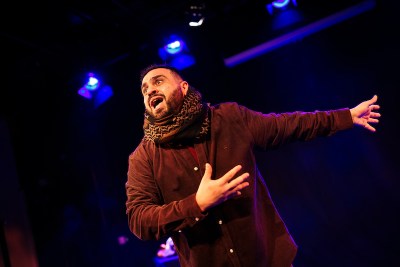
Tigar is simply sensational in this role. Tigar’s technical control is so entrancing that you cannot take your eyes off him. He uses a subtle switch in facial expressions to capture the different characters from Jaku’s life while embodying the complex emotions running through Jaku as he retells his story. Indeed, it is the subtlety that makes this performance stand out. Amid the horror, it would be easy to be swept along in hyperbolic delivery, yet Tigar works hard to present a vulnerable yet determined Jaku, desperate to survive, in a performance that is so authentic you would be forgiven for thinking it is Jaku himself on stage.
James Noone’s set design is simple yet malleable. The wooden slats and iron bars double well as both classrooms and concentration camps, perhaps a nod to the seamlessness with which the horrific ideology swept through Nazi Germany. While simple, it is particularly effective in thrusting Jaku to the centre stage and rightly forcing attention constantly upon Tigar’s gripping delivery.
At one point in the play, Jaku advises that ‘without friendship we are lost’. It is this sentiment that the production hinges upon. Jaku uses the audience as a new friend to rehearse his life story, too, but moreover, it is a production that reveals the truly destructive consequences for society when it fails to keep its compassion.
The Happiest Man on Earth is an exquisite monologue that captures the beauty of the human spirit and one man’s resilience when the world he knew appeared to have lost theirs. You would be forgiven, given the source material, for thinking the title was a misnomer, but the last ten minutes of the monologue presents Jaku’s remarkable strength as he tries to find his identity in a post-Holocaust world, leaving the stage in a moment of poignancy.
The story of Eddie Jaku is an inspiration and one that will keep the Holocaust survivor’s memory rightly alive for years to come.




 Read About Stuff | London Theatre Reviews & Culture