This review was originally written for The Reviews Hub: https://www.thereviewshub.com/phantasmagoria-southwark-playhouse-borough-london/
Phantasmagoria, or the concept of real or imaginary images that seem as if from a dream is the title of playwright Deepika Arwind’s work, and it is this blending of what is real, or what is not, that forms a large part of Arwind’s psychological thriller.
The production is set in the summerhouse of a dilapidated manor, where two political rivals, Mehrosh and Bina, are set to square off in a political debate that pits two polarising ideologies against each other. What follows is an intriguing battle of wits as Mehrosh wrestles with not just Bina’s wit, but threats upon her life and those around her. Arwind’s work, though set in an imaginary country, clearly draws parallels with the political situation in the UK, using Bina’s character as the stereotypically elite lawmaker and Mehrosh as the angry student fighting for equality, and while this head-to-head between the two rivals at first is intriguing, it does become a little too obvious as the piece unfolds.
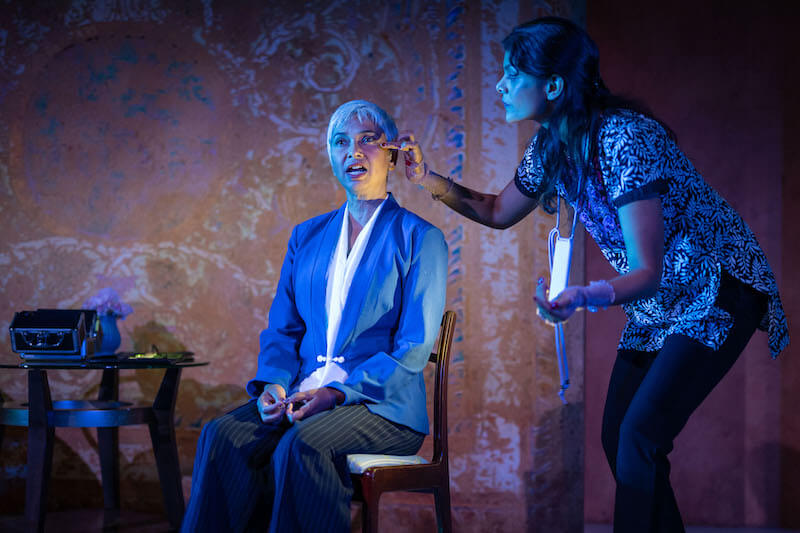
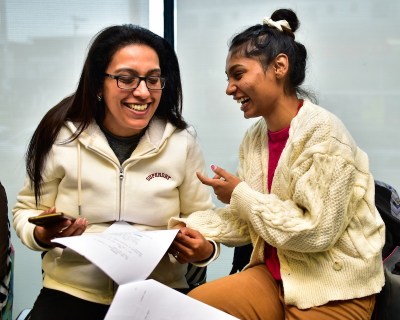
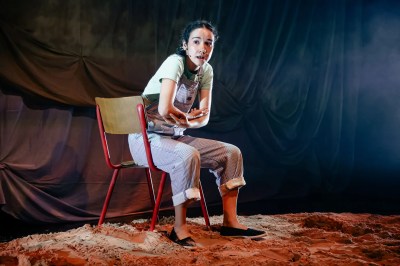
Mehrosh (Hussina Raja) is a strong-willed student who arrived at the house fearing for her life as well as her country. Raja’s depiction of Mehrosh is a thoughtful one, particularly as the character struggles with the blending of reality and illusion as her anxieties take hold. As Mehrosh interacts with all three other characters, small glances of her eyes, or a twitch of the face betrays Mehrosh’s true feelings, and Raja appears at ease delivering Arwind’s work. As the play progresses and the psychological battle of wits takes its toll on the young Mehrosh, Raja’s portrayal of her vulnerability is a nice contrast to her more assured entrance.
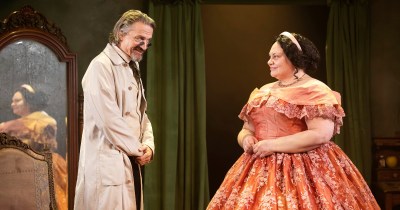
Bina (Tania Rodrigues) is a more assertive individual, and Rodrigues steals the show with this eye-catching performance. Everything in Rodrigues’ characterisation of Bina oozes power, right down to the meticulous and slow movements Bina has across the stage. Bina is, it seems, the embodiment of the cruel, intolerant, political elite hiding behind a thin veil of love, and it is Bina’s character who evokes the most unsettling feelings in this play, quietly pulling the strings. It is characters, and political ideologies like Bina’s, that Arwind’s play is flagging, about how such individuals slot themselves into power, to the detriment of the population, if Mehrosh is to be believed. It is not, though, a performance without tenderness, and you could be forgiven for initially seeing Bina as a one-dimensional figure of authority. In moments where the mask slips, Bina’s strong will comes out making her the most intriguing character of the play.
Scherezade (Ulrika Krishnamurti) is Bina’s assistant and, initially, a form of some kind of comic relief. That said, there is an eerie aura around Scherezade, who often lurks and lingers in the periphery, which casts initial suspicion about her true motives. As the narrative unfolds, it becomes clear that Scherezade represents the masses swept up by Bina’s powerful elite, targeted for their needs and their subservience, and moments with Mehrosh provide Scherezade with some much-needed depth and lucidity. Krishnamurti does well to straddle the two very different sides of the character and has some of the play’s rawest moments to contend with.
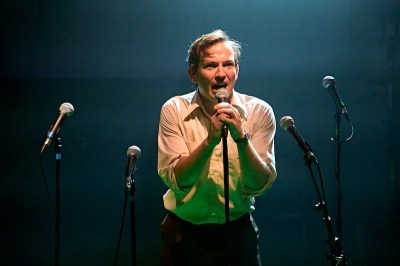
Jai (Antony Bunsee) is oddly one-dimensional against the fascinating three other characters. Bunsee does well with the awkward material Jai has, and a scene roughly halfway where Jai’s sanity comes into question is a shocking moment. A staple of the newsroom world before turning his back on conventional media, it’s Jai’s character who has orchestrated this debate between the two rivals, and it is never really clear where Jai’s loyalties lie, seemingly tied to both Mehrosh and Bina. It would have been interesting to have this play out a little further, and have Jai to be slightly more than thread between scenes, but Bunsee does well to bring some character to the material offered.
Despite a talented cast, the real highlight of this production is the wonderful lighting designs. Arwind, in the playscript, talks of ‘horror theatre’, and that lights, and shadows, contribute hugely to this effect, and this idea runs through this production. Neill Brinkworth’s lighting design is innovative and suits the intimate environment of the Southwark Playhouse’s ‘Little’ space. This mainly takes hold during the extensive sections where the characters find themselves in a power cut triggered by a violent storm. Underscored by an increasing torrent of rain, characters rely on their phone torches to illuminate themselves, and this design choice enables characters to manipulate lighting for dramatic effect, such as the ghoulish facial expressions of Jai during a particularly macabre monologue, or enhancing the tender gesticulations of Scherezade during a warm moment between her and Mehrosh. This is a cleverly designed lighting rig and while it’s not horror in the conventional form, the lights do often capture the fierce facial expression or violent gesture in a way that does, for a moment, spark a nervous reaction.
Arwind’s play promises to be a psychological horror, something designed to capture the horror of the world the playwright feels so bleakly about in the programme notes. In truth, there isn’t a great deal of terror in this play, but perhaps that is the point. The horror that Arwind wishes to expose is not a jump scare or a scene of violence, but instead the brutal view of corrupt political landscape. At just over 90 minutes, there is certainly enough in this piece to keep interest, and while some of the symbolism and dialogue are a little clunky, this is a production delivered successfully by a brilliant quartet and supported by some of the best lighting choices out there.
This show might not change the way you think, but there is enough about it to get you thinking, as Arwind forces us to consider whose side we are on in a shifting political landscape. Laced with a severe warning from Arwind about the direction she feels the world is heading in, the true horror, it seems, is the ease with which this shift is happening.



 Read About Stuff | London Theatre Reviews & Culture