
This review was originally written for The Reviews Hub: https://www.thereviewshub.com/jumping-the-shark-orchard-theatre-dartford/
There is heart and laughter in David Cantor and Michael Kingsbury’s new comedy, Jumping the Shark, which lands well thanks to its hard-working and talented cast.
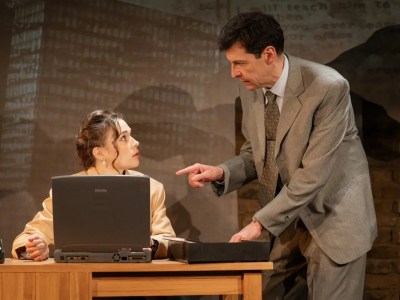
Cantor and Kingsbury’s play, which Kingsbury also directs, pays homage to the sitcoms of today and yesteryear as five strangers converge on a tiny hotel conference room for the weekend, hoping to learn how to write the next hit sitcom under the tutelage of sitcom extraordinaire Frank (David Schaal). As the writing course unfolds, so do the lives of the wannabe writers as Frank urges them to find their truth before putting pen to paper, with Frank himself learning a few home truths along the way.
Schaal’s Frank is a complex character. Revered by the characters who have paid to listen to his advice, it becomes clear that Frank himself has a few secrets hidden himself, and Schaal does well to draw out Frank’s more humble and tender side within this two-hour comedy. Schaal, an adept comedy actor, is given time to shine in Act One in a wonderful monologue which pays homage to several well-known sitcoms, drawing from the catchphrases and characterisations of iconic characters such as Basil Fawlty and Del Boy to set the scene for this meta comedy.
While Schaal’s course leader Frank drives the narrative forward, the production is then fleshed out by the wannabe writers who are all aiming to write the next hit. These are all clearly designed to reflect the typical sitcom protagonist. Pam’s the downtrodden housewife, Gavin’s a flamboyant out of work actor, Dale’s a working-class tradesman with aspirations of a better life. Morgan’s angry at the world and its capitalist way and his approach could be likened to 70s sitcom classic Citizen Smith, while Amy’s desire to push back against patriarchal oppression and fight to establish true female characters perhaps reflects the growing number of sitcoms with similar protagonists, such as Fleabag.
Sarah Moyle’s Pam is probably the most interesting of these five characters, wrestling with her writing dream while also battling a cruel and unloving husband at home. Moyle’s understated Pam gets some of the biggest laughs of the night, with Moyle’s comic timing impressively on display. One of the plot points of the show is when the five have to deliver scenes from their own sitcom, with Pam’s arguably being the funniest, and deserving of the applause it receives after.
Robin Sebastian’s Gavin is a struggling actor desperate for his next big break and he injects a great deal of energy into the performance, particularly in the second half, with one moment, where Gavin leads the others in an acting warm up, being one of the show’s funnier and sillier moments.
As Amy, Jasmine Armfield initially establishes a nerdy and keen-to-impress student as she races on stage in an almost farcical manner under the weight of her massive overnight bag. As the play unfolds, it comes clear that Amy has some scores to settle through her writing, and Armfield does well to land the production’s more serious moments amid the array of punchlines.
Jack Trueman’s Dale is the working-class handyman who aspires for a life with the pen rather than his toolkit, and Trueman’s larger than life characterisation makes Dale’s character standout in this loudmouth performance. Dale’s simplistic yet desperate approach to life is surprisingly tender, even if a little shocking, as he reveals a few more truths than he should late in the play.
The final character in the writing group is Harry Visinoni’s Morgan. Swaggering in upon Morgan is the closest the play comes to absurdism, as Morgan’s writing style, and jarring switches to rhyme, is a reminder that comedy can be anarchic too. Visinoni’s control of his lines brings a lyrical quality to these rhymes, but what is also strong is how Visinoni’s characterisation helps us to understand the root of Morgan’s problems and frustrations, which comes out in a surreal yet sad way in Act Two.
Taking its title from a concept that most writers try to avoid (‘jumping the shark’ refers to when a show abandons its roots in order to chase a different kind of story), the play largely achieves its aims in paying homage to some of the most iconic sitcoms while creating a comedy itself. The ploddy first half, short and limited on laughs, is made up for by a fun and genuinely amusing second half that plays well with the tropes of comedy in this very meta production. Jumping the Shark is a simple production which leans heavily on its actors to earn the laughs, but by the end is deserving of the applause.





 Read About Stuff | London Theatre Reviews & Culture